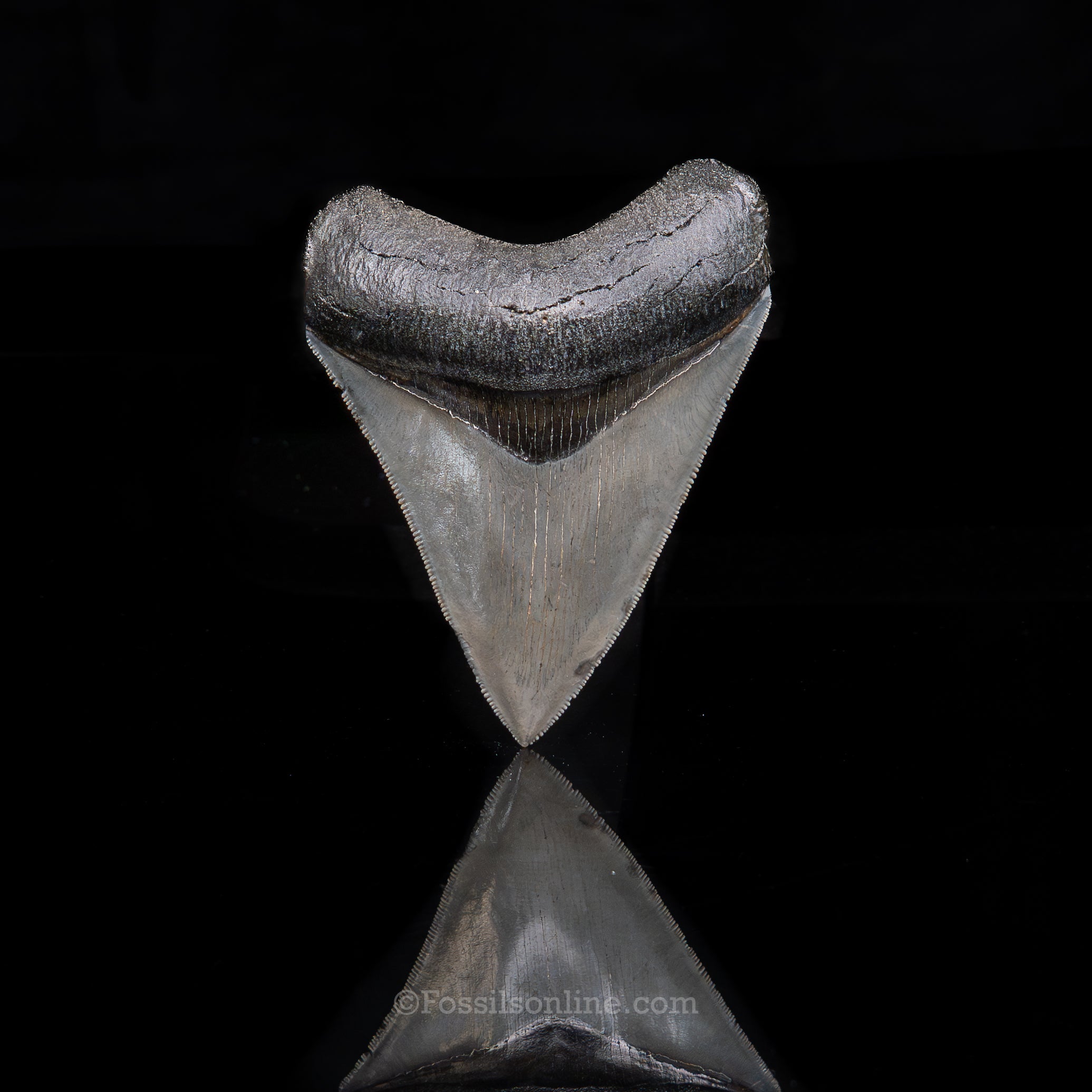
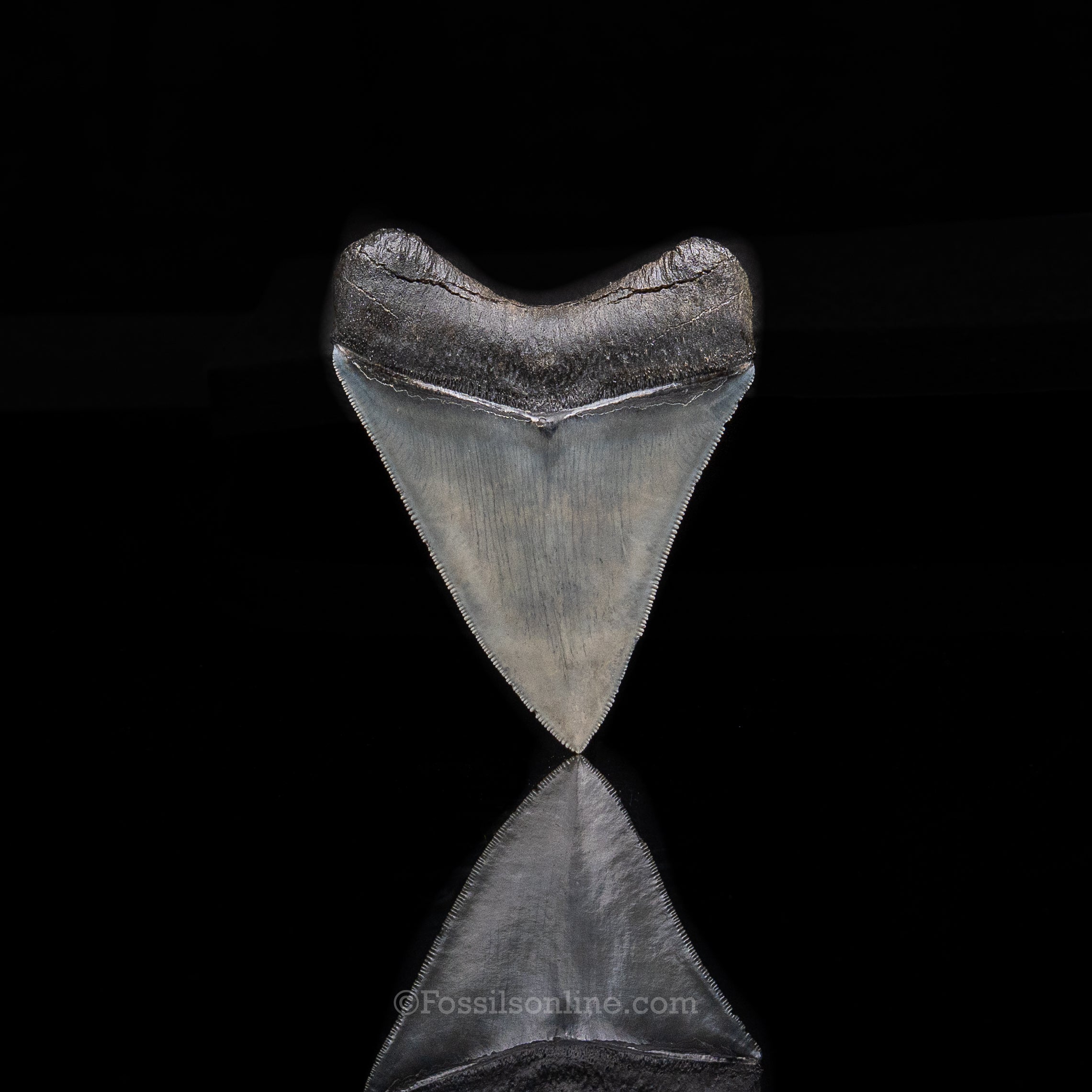
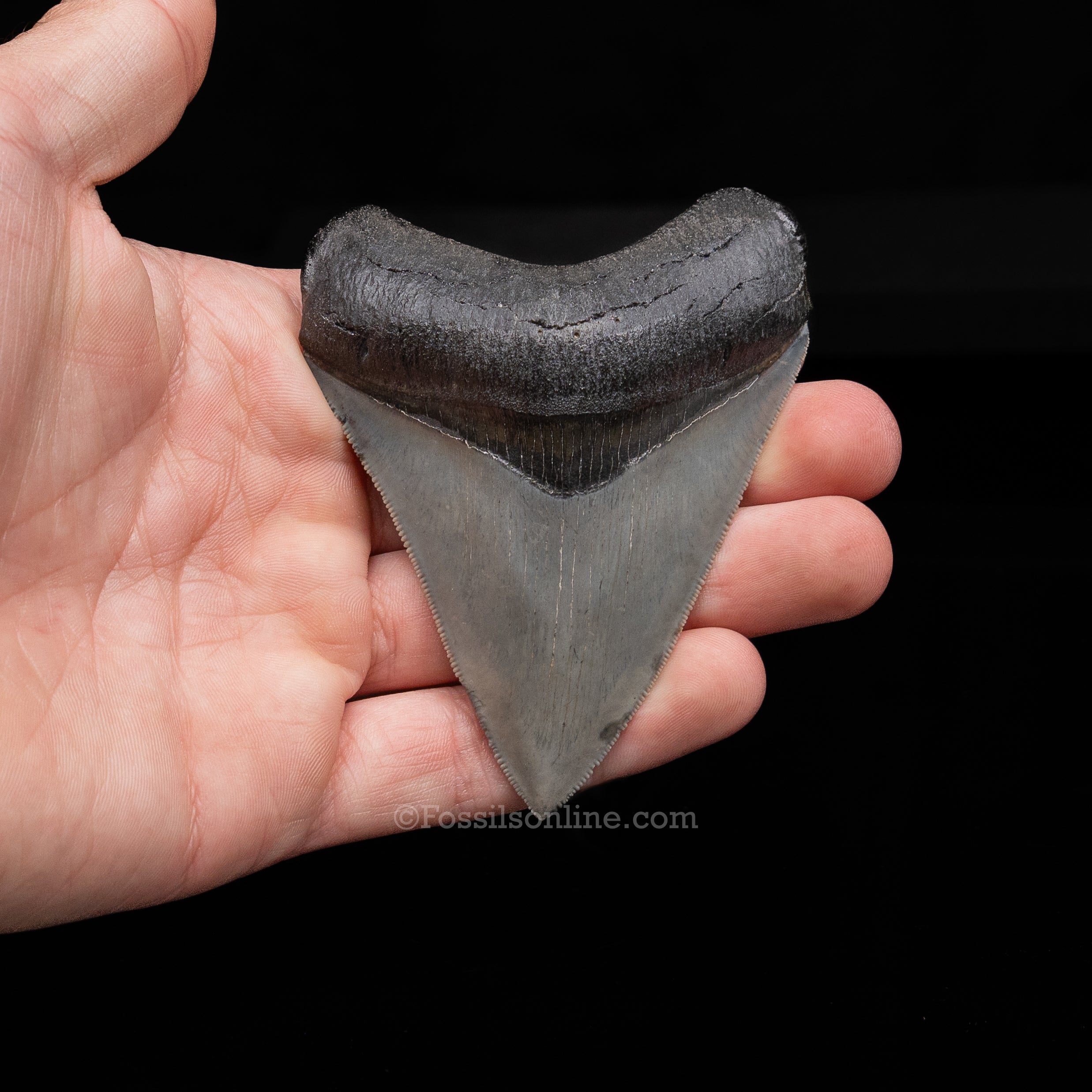
Venice Megalodon 3.5"
This is a gorgeous Megalodon tooth from Venice, Florida with classic Venice beach colors. No enamel cracks with a solid root. It has sharply serrated edges, pointy tip, a glossy enamel and a beautiful shiny jet black bourlette.
Megalodon teeth from Venice, FL
The Venice, Florida area is often called the “Shark Tooth Capital of the World,” and for good reason. Just offshore of Venice’s modern beaches lies a broad, shallow Gulf shelf cut by ancient river channels and dotted with fossil-bearing sediments. These deposits include Miocene and Pliocene marine and nearshore layers that once formed warm coastal seas—exactly the kind of habitat Megalodon preferred, along with the whales and marine mammals it hunted. As sediments built up on the seafloor, teeth and other hard parts were buried, protected, and slowly fossilized.
Over millions of years, changes in sea level, storms, and currents have eroded and re-exposed those fossil-rich layers. Offshore ledges, low spots, and shell beds now act like natural traps where teeth accumulate. On top of that, modern beach renourishment, dredging projects, and natural wave action carry fossils from offshore deposits onto the beaches. Divers exploring offshore Venice, boaters working the nearshore bottom, and everyday beachcombers walking the surf line all tap into the same ancient source. That’s why so many Megalodon teeth—especially those sold along Florida’s Gulf Coast—trace back to the waters and sediments off Venice. The combination of the right age rocks, prime ancient shark habitat, and easy modern access makes this area a steady producer of teeth year after year.
Why Venice, Florida Megalodon teeth are so sought after
Megalodon teeth from Venice aren’t just fossils—they’re part of a very specific story and place, and that’s a huge part of their appeal. Collectors and beach hunters seek Venice-area teeth for several reasons:
-
The “Shark Tooth Capital” factor – Owning a tooth from Venice means owning a piece of a world-famous fossil destination. For many people, their first Megalodon tooth came from wading the surf or sifting the sand here.
-
Local adventure and memory – These are fossils you can actually find yourself on a family trip or dive charter, then bring home as a permanent reminder of Venice’s beaches and Gulf waters. Even purchased specimens often come with that “Venice story” attached.
-
Classic Gulf Coast look – Venice teeth develop rich, phosphate-driven colors and heavy mineralization that collectors immediately recognize. A “Venice Meg” has its own personality compared to teeth from the Atlantic side or other states.
-
Strong display presence – Dark, glossy crowns and dense roots give Venice teeth a bold, dramatic look in a case or on a stand. Even medium-sized teeth often feel chunky and substantial in the hand.
You still get that big “museum fossil” vibe, but with a strong sense of place: not just “a Megalodon tooth,” but a Megalodon tooth from Venice, Florida—dug from the same offshore sediments that keep this town on the fossil-hunter’s map.
Why Venice Megalodon teeth are often smaller than Carolina teeth
Collectors quickly notice that Megalodon teeth from Venice usually don’t reach the giant sizes seen in some famous Carolina finds. There are a few reasons for that:
-
Different parts of the shark’s range – The classic huge Carolina teeth often come from deeper offshore ledges cut into big, stable Miocene–Pliocene formations that represented major hunting grounds for full-grown adults. Much of the Venice material, by contrast, is reworked from shallower nearshore deposits, channels, and mixed shell beds that may have included more juveniles and subadults. That naturally skews average tooth size smaller.
-
Energy of the environment – Venice teeth are constantly moved by waves, storms, dredging, and longshore currents. Larger teeth are more likely to be broken, rolled, or fragmented before they ever reach the beach, while smaller, sturdier teeth can survive that tumbling a bit better. Many of the truly big Venice teeth never make it ashore intact.
-
Access and collecting bias – In the Carolinas, divers and commercial operations target very specific offshore ledges in 80–120+ feet of water where big adult teeth concentrate. Around Venice, a huge amount of material is found by casual shallow diving in areas where the teeth have already been moved and sorted by water energy. The result is that Venice produces lots of teeth, but the average size is smaller, and true “monster” teeth are rarer.
That doesn’t make Venice teeth any less desirable—it just means they tell a slightly different part of the Megalodon story: a Gulf Coast environment where sharks of many sizes cruised warm, shallow seas, and where time, waves, and currents have favored a steady stream of smaller-to-medium, beautifully colored teeth washing up on the sand.
How Megalodon got so large
Megalodon’s gigantic size is the result of several evolutionary advantages coming together:
Warm-blooded-ish lifestyle (regional endothermy)
Evidence from microscopic tooth and scale structures suggests that Megalodon could keep parts of its body warmer than the surrounding water, similar to some modern sharks (like great whites and makos). That warm, high-energy physiology helped it grow fast and power a huge body.
Plenty of big prey
During the Miocene and Pliocene, the oceans were full of whales and other marine mammals. A shark adapted to specialize on large, calorie-rich prey could afford to grow massive—each successful hunt provided a huge energy payoff.
Streamlined body built for cruising
Newer research suggests Megalodon may have had a more elongated, hydrodynamic body shape than the bulky versions often shown in older reconstructions. A sleeker design would reduce drag, making it easier for a huge shark to cruise long distances in search of food.
Why teeth are found, not skeletons
One of the most common questions is: “If Megalodon was so big, why don’t we find full skeletons?” The answer comes down to shark biology and fossilization:
Cartilage doesn’t fossilize well
Shark skeletons are made mostly of cartilage, not solid bone. After the shark dies, that cartilage decays and falls apart quickly, leaving little behind that can mineralize and survive millions of years.
Teeth are built to last
Megalodon teeth are thick, heavily mineralized, and coated in hard enamel. They handle crushing, biting, and even being rolled around on the seafloor far better than soft cartilage ever could.
Sharks constantly shed teeth
Like modern sharks, Megalodon replaced its teeth throughout its life. A single animal could shed thousands of teeth, each one a potential fossil waiting to be buried, preserved, and discovered later.
That’s why teeth are by far the most common Megalodon fossils. Occasionally, vertebrae and other fragments are found, but the teeth are what fill collections, museum exhibits, and jewelry cases around the world.
Megalodon’s disappearance
Megalodon ruled the oceans for roughly 15 million years before disappearing around 3.6 million years ago. Scientists are still debating why it went extinct, but leading ideas include:
-
Cooling oceans as the climate shifted, which may have reduced suitable warm-water habitat.
-
Changes in prey, as whale species evolved and some migration patterns shifted.
-
New competition from emerging predators like early great white sharks and toothed whales (orcas and their relatives), which may have hunted similar prey or even Megalodon juveniles.
Whatever the exact cause, by the time people were walking the beaches of what is now southwest Florida, Megalodon had been gone for millions of years—leaving its teeth as the main evidence it was ever here.
Color, preservation, and the “look” of Venice-area teeth
Collectors quickly learn to recognize teeth from the Venice, Florida area by their overall look and feel. Many Gulf Coast Megalodon teeth from this region show classic dark, phosphate-rich colors—jet black, charcoal, or deep chocolate browns—often with glossy enamel and heavily mineralized roots. Some specimens pick up lighter tans or smoky grays, but Venice teeth are especially famous for those rich, dark tones that come from long burial in phosphate-bearing marine sediments.
Teeth brought in by dredging and wave action are often well-worn and polished by sand and surf, giving them a smooth, almost tumbled appearance. Others, especially those recovered directly from offshore ledges by divers, can retain sharper details: crisp serrations, clean cutting edges, and strong bourlettes between the crown and the root. The roots themselves are typically dense and solid in the hand, a sign of heavy mineralization and long-term preservation on the seafloor.
Because these fossils have spent millions of years in moving Gulf waters, every Venice Megalodon tooth carries its own unique combination of color, sheen, and wear. Some are glossy and jet-black, others matte and chocolate-brown, some show streaks, spots, or subtle color shifts where different minerals soaked into the enamel and root. No two are exactly alike—which is a big part of the charm. Each tooth is a one-of-a-kind piece of ancient Florida seafloor, brought up from offshore Venice and ready to be displayed as a genuine remnant of the largest predatory shark that ever lived.
Golden Beach vs Venice – subtle color differences
Within the Venice area, different beaches and nearshore zones can give teeth slightly different “signatures,” and collectors love to talk about those local variations. Golden Beach, a neighborhood and stretch of shoreline within Venice, is known for producing teeth with its own range of tones shaped by local sand, shell, and sediment mixes.
Teeth from Golden Beach often show:
-
Deep blacks and charcoals with a slightly satin sheen from constant tumbling in beach sand.
-
Warm browns and honey-chocolate hues, especially on the roots and bourlette.
-
Occasional lighter or mottled crowns where minerals have soaked in unevenly.
Teeth from the broader Venice beach and offshore area can cover an even wider palette:
-
Jet-black, glossy crowns from heavily phosphate-rich pockets.
-
Smoky grays, dark steel, and slate tones in enamel, sometimes with subtle blue or greenish hints.
-
Dense, dark roots that feel heavy in the hand, sometimes contrasting with slightly lighter crowns.
In practice, these differences blur together—waves don’t respect beach names—but for locals and collectors, it’s fun to note where a tooth came from. A tray of Venice Megalodon teeth will show a beautiful spectrum of Gulf Coast colors, from Golden Beach honey-browns to classic deep-black offshore specimens. That variety in color and patina is part of what makes Venice, Florida teeth so visually appealing and so addictive to collect.
LOCATION
Venice, FL
Size
4.02"
Choose options