

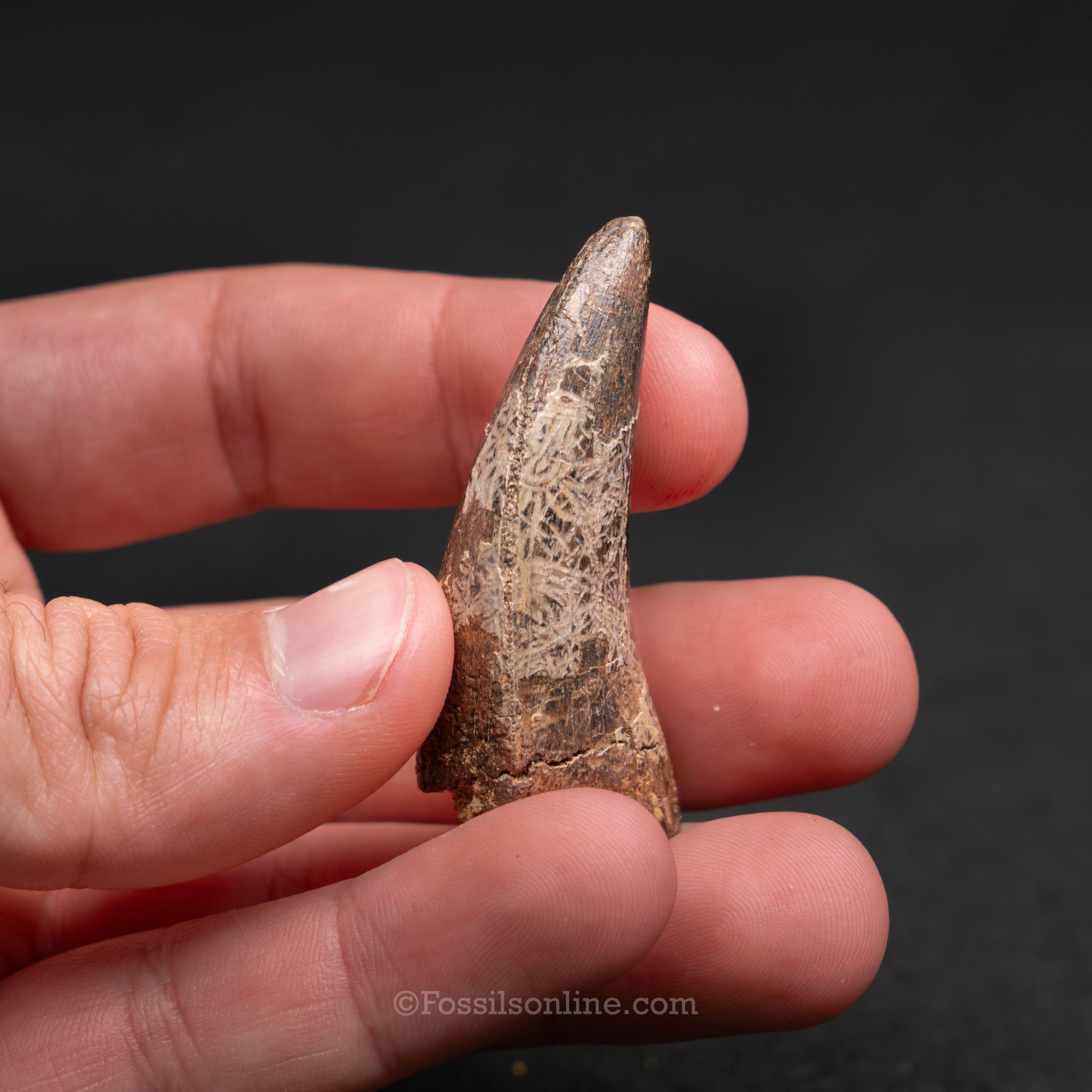
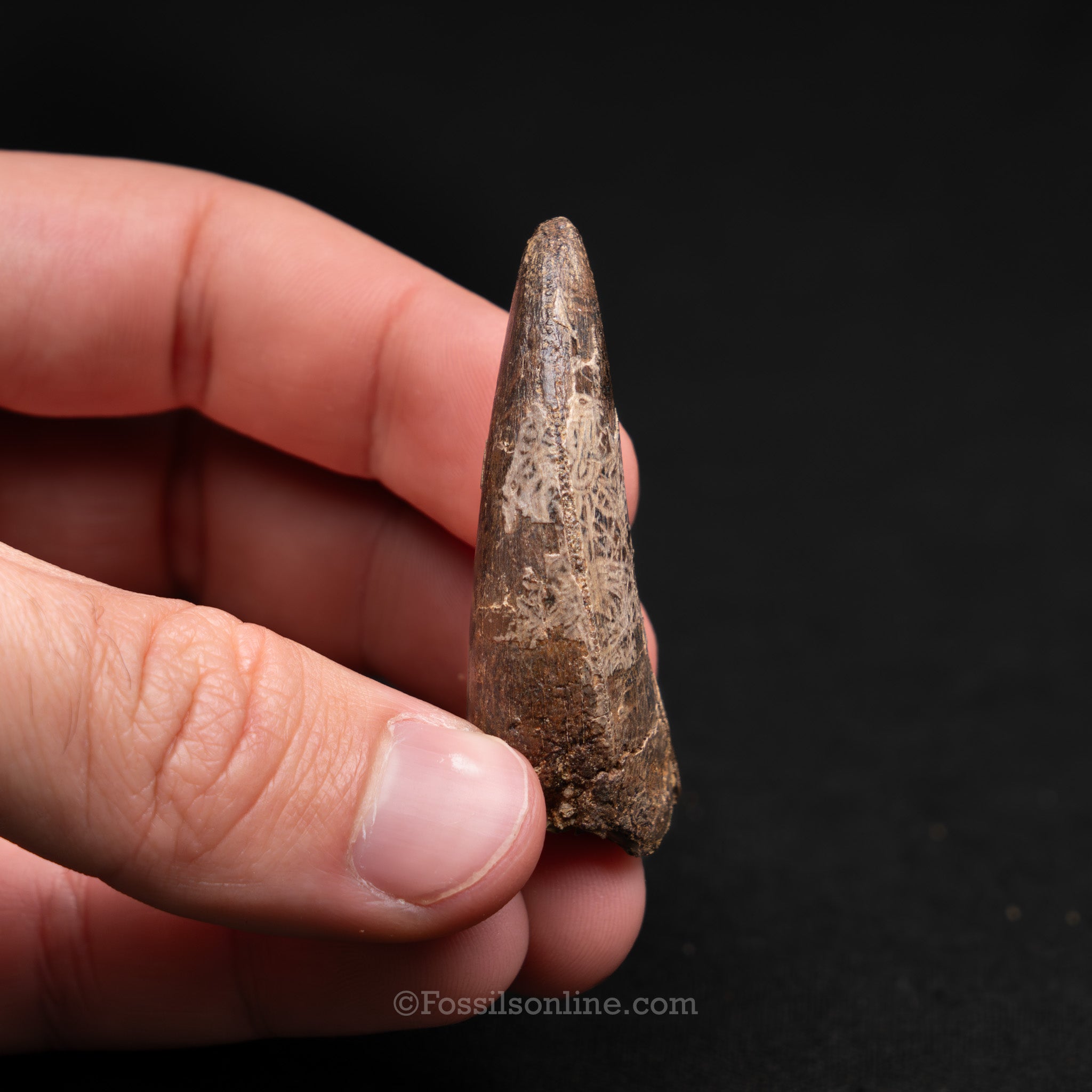
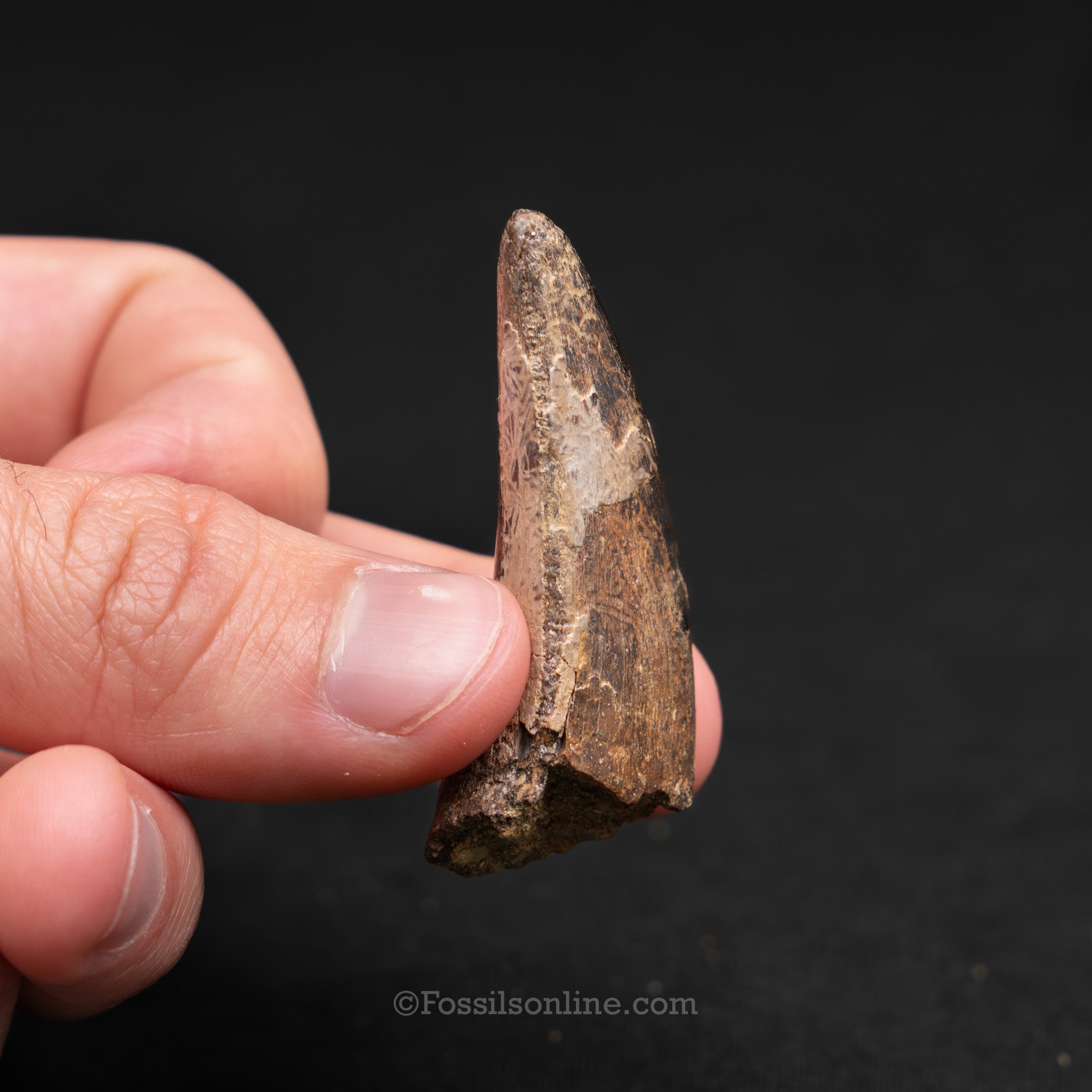
Tyrannosaurus rex Tooth 1.98"
T. rex is the holy grail dinosaur, the most recognizable dinosaur ever discovered; everyone knows its name. This T. rex tooth is from the Lance Formation in Wyoming. It’s been over 60 million years since this tooth was buried, tumbled, and tossed around. It was found near the surface, where roots and weather took their toll. It’s weathered and worn, but still shows where sharp serrations used to cut into dinosaurs like Triceratops and Edmontosaurus. Remnants of glossy enamel remain where roots excreted acids, slowly staining the enamel with white streaks. This tooth came from the largest North American predator to ever exist, survived millions of years in the Wyoming grasslands, and is now ready to be displayed in your collection.
No repair or restoration.
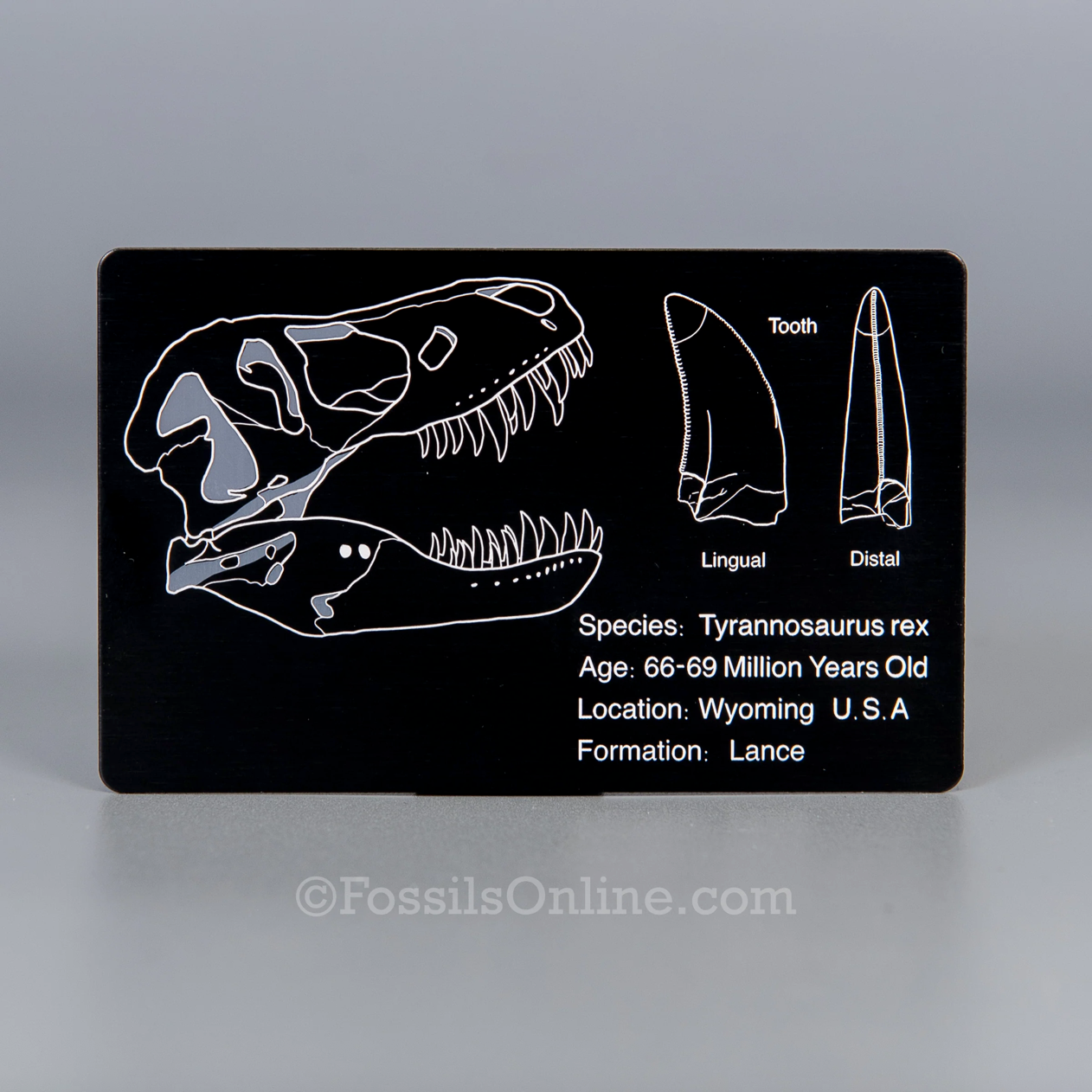
Laser etched ID card included and floating display case.
Tyrannosaurus rex is the dinosaur most people picture when they hear the word “dinosaur” – a massive, deep-skulled predator with huge jaws, banana-sized teeth, and powerful legs. It lived at the very end of the Cretaceous Period, about 68–66 million years ago, in what is now western North America. Its fossils come mainly from formations like Hell Creek, Lance, and Scollard, which record the last few million years before the dinosaur extinction.
For collectors, T. rex is the ultimate “headline” carnivore: rare, heavily regulated, incredibly desirable, and instantly recognizable even to someone who has never studied paleontology. Owning a real T. rex fossil – even a tiny fragment or tooth – means holding a piece of the most famous predator of all time.
Why T. rex fossils (especially teeth) are so rare and expensive
Compared to something like Spinosaurus or Kem Kem “raptors,” T. rex material is dramatically scarcer and more costly. Reasons include:
-
Limited formations and range – T. rex is only found in a handful of Late Cretaceous formations in North America. That’s a much narrower geological and geographic window than, say, Moroccan theropods.
-
Fewer individuals – T. rex was a top predator; ecosystems never support huge numbers of apex predators compared to herbivores or smaller carnivores. Fewer animals in life equals fewer fossils in the ground.
-
Land access and regulations – The best T. rex sites are often on private ranch land or in areas with strict rules about collecting and ownership. Excavation is expensive, time-consuming, and heavily scrutinized.
-
High demand and name recognition – Everyone knows T. rex. Museums, serious collectors, and the general public all want a piece of it, which drives prices up whenever legitimate material appears.
All of that adds up to T. rex teeth being far rarer and more valuable on the market than comparable-sized teeth from many other theropods. Even small or partial teeth can be highly prized because they carry that T. rex name and provenance.
Discovery and how T. rex became an icon
T. rex was first described in the early 1900s from finds in the American West, and it quickly grabbed public attention. Early mountings of massive skeletons in museums like the American Museum of Natural History and the Field Museum helped cement T. rex in popular imagination as the “king of the dinosaurs.”
Over the last century, more complete skeletons have been found, but they’re still incredibly rare. Each major T. rex specimen gets its own nickname (like “Sue” or “Stan”) and an entire scientific and legal story around it. That combination of rarity, size, and media coverage is a big part of why T. rex is so iconic today.
Size, build, and where it lived
T. rex was one of the largest land predators ever:
-
Length: about 12–13 meters (40–43 feet) for large adults
-
Hips: around 4 meters (13 feet) tall
-
Mass: commonly estimated around 7–9 tons, with some individuals possibly heavier
It lived in a broad region that includes modern Montana, Wyoming, the Dakotas, and parts of Canada, in warm, seasonal floodplains with rivers, forests, and coastal swamps. T. rex shared this world with large herbivores like Triceratops and Edmontosaurus, plus a host of smaller dinosaurs, crocodiles, turtles, and early birds and mammals.
What made T. rex different from other big theropods
T. rex wasn’t just big – it was built in a very particular way that sets it apart from other giant meat-eaters:
-
Huge, deep skull – Shorter and deeper than Spinosaurus or Carcharodontosaurus, built like a living wrecking ball.
-
Bone-crushing teeth – Thick, round “banana” teeth, heavily serrated and reinforced, capable of biting through bone and armor, not just flesh.
-
Powerful bite – Among the strongest bite forces known in any land animal; its jaws could punch holes through the bones of large dinosaurs.
-
Robust body – Massive hips, strong tail, and powerful legs; not built for extreme speed like a cheetah, but for stability, power, and bursts of fast movement.
-
Short arms (but not useless) – Small compared to the rest of the body, but heavily muscled and likely still useful for grappling or helping push itself up.
Where Spinosaurus was adapted to water and fish, and some other theropods to slicing flesh, T. rex was the land-based bone-crusher, a specialist in taking down or scavenging large, heavily built dinosaurs.
Lifestyle – hunter, scavenger, or both?
The “hunter vs. scavenger” debate has surrounded T. rex for decades, but the best evidence points to both:
-
Hunter:
-
Strong legs and sturdy build for powering into a charge.
-
Binocular vision and forward-facing eyes for depth perception.
-
Healed bite marks on the bones of prey species like Triceratops and hadrosaurs show some victims survived attacks – proof T. rex sometimes bit dinosaurs while they were still alive.
-
-
Scavenger:
-
Incredible sense of smell, indicated by large olfactory regions in the braincase.
-
Bone-crushing jaws ideal for cracking carcasses and devouring everything, not just soft tissue.
-
In nature, almost any large predator will scavenge when the chance comes. T. rex was no different – it was a flexible top carnivore, capable of both chasing down prey and taking advantage of every carcass it found.
Teeth – built-in bone-cracking tools
T. rex teeth are some of the most distinctive in the dinosaur world:
-
Shape: Thick, robust, and banana-shaped, not thin and blade-like.
-
Serrations: Large, prominent serrations on both edges, acting like a giant steak knife.
-
Structure: Internally reinforced, with microscopic features that helped resist cracking under huge forces.
These teeth weren’t just cutting tools – they were crushing weapons. T. rex could bite with enough force to shatter bone, swallow large chunks, and digest a lot of material inside a carcass, not just muscles and organs.
Like other theropods, T. rex replaced its teeth throughout life, but not at the insane rate of a shark. Each tooth position would cycle through new teeth over time, so a single individual still produced many teeth over its life. That’s why teeth are the most commonly collected T. rex fossils—but they’re still rare compared to abundant species from more accessible formations.
Growth and life stages – from “teen rex” to titan
T. rex didn’t hatch as a giant. Growth studies using bone histology show it had a slow childhood followed by a massive teenage growth spurt:
-
Juveniles – More lightly built, long-legged, and faster; sometimes nicknamed “teen rexes.” They may have filled a different ecological niche than the massive adults, chasing smaller, faster prey.
-
Subadults – Rapid growth in size and mass, with skulls and teeth becoming deeper and more robust as they approach adult form.
-
Adults – Fully massive, bone-crushing predators with deep, heavily reinforced skulls and the classic proportions we think of as “T. rex.”
This changing body shape with age is one reason there’s debate about whether some smaller tyrannosaur fossils (like those historically called Nanotyrannus) are separate species or just juveniles of T. rex. Either way, the growth curve shows T. rex transformed from a relatively lean, fast teenage predator into a slow-growing but incredibly powerful adult.
T. rex and its prey
One of the most compelling parts of the T. rex story is the prey it lived with:
-
Triceratops – Horned giants with bone shields and massive brow horns. Bite marks on Triceratops skulls and frills show they sometimes ended up in T. rex jaws.
-
Hadrosaurs (duck-billed dinosaurs) – Large, herd-forming herbivores that likely made up a major portion of T. rex’s diet. Many hadrosaur bones show healed or fatal T. rex bite marks.
These predator–prey relationships mean that a T. rex fossil is never just “a bone” or “a tooth.” It’s part of a dramatic, well-documented ecosystem, where each bite mark, healed wound, and scattered bonebed tells a story about hunting, scavenging, and survival at the end of the Age of Dinosaurs.
Why collectors love T. rex
T. rex isn’t just another dinosaur; for many people, it’s the dinosaur. Collectors are drawn to it because:
-
It’s the most famous carnivorous dinosaur in the world.
-
Authentic material is genuinely rare, giving even tiny pieces significant prestige.
-
The science around T. rex is rich and constantly growing—new studies on its growth, senses, and behavior appear regularly.
-
Every T. rex fossil, from tooth fragments to more complete elements, ties directly into the legendary Hell Creek/Lance ecosystem at the very end of the Cretaceous.
Whether it’s a small tooth, a root fragment, or a more complete element, a T. rex fossil is a centerpiece by default—a physical connection to the apex land predator of the Late Cretaceous, and a tangible piece of the story that has defined “dinosaur” in the public imagination for over a century.
T. rex is the holy grail dinosaur, the most recognizable dinosaur ever discovered; everyone knows its name. This T. rex tooth is from the Lance Formation in Wyoming. It’s been over 60 million years since this tooth was buried, tumbled, and tossed around. It was found near the surface, where roots and weather took their toll. It’s weathered and worn, but still shows where sharp serrations used to cut into dinosaurs like Triceratops and Edmontosaurus. Remnants of glossy enamel remain where roots excreted acids, slowly staining the enamel with white streaks. This tooth came from the largest North American predator to ever exist, survived millions of years in the Wyoming grasslands, and is now ready to be displayed in your collection.
No repair or restoration.
Laser etched ID card included and floating display case.
Tyrannosaurus rex is the dinosaur most people picture when they hear the word “dinosaur” – a massive, deep-skulled predator with huge jaws, banana-sized teeth, and powerful legs. It lived at the very end of the Cretaceous Period, about 68–66 million years ago, in what is now western North America. Its fossils come mainly from formations like Hell Creek, Lance, and Scollard, which record the last few million years before the dinosaur extinction.
For collectors, T. rex is the ultimate “headline” carnivore: rare, heavily regulated, incredibly desirable, and instantly recognizable even to someone who has never studied paleontology. Owning a real T. rex fossil – even a tiny fragment or tooth – means holding a piece of the most famous predator of all time.
Why T. rex fossils (especially teeth) are so rare and expensive
Compared to something like Spinosaurus or Kem Kem “raptors,” T. rex material is dramatically scarcer and more costly. Reasons include:
-
Limited formations and range – T. rex is only found in a handful of Late Cretaceous formations in North America. That’s a much narrower geological and geographic window than, say, Moroccan theropods.
-
Fewer individuals – T. rex was a top predator; ecosystems never support huge numbers of apex predators compared to herbivores or smaller carnivores. Fewer animals in life equals fewer fossils in the ground.
-
Land access and regulations – The best T. rex sites are often on private ranch land or in areas with strict rules about collecting and ownership. Excavation is expensive, time-consuming, and heavily scrutinized.
-
High demand and name recognition – Everyone knows T. rex. Museums, serious collectors, and the general public all want a piece of it, which drives prices up whenever legitimate material appears.
All of that adds up to T. rex teeth being far rarer and more valuable on the market than comparable-sized teeth from many other theropods. Even small or partial teeth can be highly prized because they carry that T. rex name and provenance.
Discovery and how T. rex became an icon
T. rex was first described in the early 1900s from finds in the American West, and it quickly grabbed public attention. Early mountings of massive skeletons in museums like the American Museum of Natural History and the Field Museum helped cement T. rex in popular imagination as the “king of the dinosaurs.”
Over the last century, more complete skeletons have been found, but they’re still incredibly rare. Each major T. rex specimen gets its own nickname (like “Sue” or “Stan”) and an entire scientific and legal story around it. That combination of rarity, size, and media coverage is a big part of why T. rex is so iconic today.
Size, build, and where it lived
T. rex was one of the largest land predators ever:
-
Length: about 12–13 meters (40–43 feet) for large adults
-
Hips: around 4 meters (13 feet) tall
-
Mass: commonly estimated around 7–9 tons, with some individuals possibly heavier
It lived in a broad region that includes modern Montana, Wyoming, the Dakotas, and parts of Canada, in warm, seasonal floodplains with rivers, forests, and coastal swamps. T. rex shared this world with large herbivores like Triceratops and Edmontosaurus, plus a host of smaller dinosaurs, crocodiles, turtles, and early birds and mammals.
What made T. rex different from other big theropods
T. rex wasn’t just big – it was built in a very particular way that sets it apart from other giant meat-eaters:
-
Huge, deep skull – Shorter and deeper than Spinosaurus or Carcharodontosaurus, built like a living wrecking ball.
-
Bone-crushing teeth – Thick, round “banana” teeth, heavily serrated and reinforced, capable of biting through bone and armor, not just flesh.
-
Powerful bite – Among the strongest bite forces known in any land animal; its jaws could punch holes through the bones of large dinosaurs.
-
Robust body – Massive hips, strong tail, and powerful legs; not built for extreme speed like a cheetah, but for stability, power, and bursts of fast movement.
-
Short arms (but not useless) – Small compared to the rest of the body, but heavily muscled and likely still useful for grappling or helping push itself up.
Where Spinosaurus was adapted to water and fish, and some other theropods to slicing flesh, T. rex was the land-based bone-crusher, a specialist in taking down or scavenging large, heavily built dinosaurs.
Lifestyle – hunter, scavenger, or both?
The “hunter vs. scavenger” debate has surrounded T. rex for decades, but the best evidence points to both:
-
Hunter:
-
Strong legs and sturdy build for powering into a charge.
-
Binocular vision and forward-facing eyes for depth perception.
-
Healed bite marks on the bones of prey species like Triceratops and hadrosaurs show some victims survived attacks – proof T. rex sometimes bit dinosaurs while they were still alive.
-
-
Scavenger:
-
Incredible sense of smell, indicated by large olfactory regions in the braincase.
-
Bone-crushing jaws ideal for cracking carcasses and devouring everything, not just soft tissue.
-
In nature, almost any large predator will scavenge when the chance comes. T. rex was no different – it was a flexible top carnivore, capable of both chasing down prey and taking advantage of every carcass it found.
Teeth – built-in bone-cracking tools
T. rex teeth are some of the most distinctive in the dinosaur world:
-
Shape: Thick, robust, and banana-shaped, not thin and blade-like.
-
Serrations: Large, prominent serrations on both edges, acting like a giant steak knife.
-
Structure: Internally reinforced, with microscopic features that helped resist cracking under huge forces.
These teeth weren’t just cutting tools – they were crushing weapons. T. rex could bite with enough force to shatter bone, swallow large chunks, and digest a lot of material inside a carcass, not just muscles and organs.
Like other theropods, T. rex replaced its teeth throughout life, but not at the insane rate of a shark. Each tooth position would cycle through new teeth over time, so a single individual still produced many teeth over its life. That’s why teeth are the most commonly collected T. rex fossils—but they’re still rare compared to abundant species from more accessible formations.
Growth and life stages – from “teen rex” to titan
T. rex didn’t hatch as a giant. Growth studies using bone histology show it had a slow childhood followed by a massive teenage growth spurt:
-
Juveniles – More lightly built, long-legged, and faster; sometimes nicknamed “teen rexes.” They may have filled a different ecological niche than the massive adults, chasing smaller, faster prey.
-
Subadults – Rapid growth in size and mass, with skulls and teeth becoming deeper and more robust as they approach adult form.
-
Adults – Fully massive, bone-crushing predators with deep, heavily reinforced skulls and the classic proportions we think of as “T. rex.”
This changing body shape with age is one reason there’s debate about whether some smaller tyrannosaur fossils (like those historically called Nanotyrannus) are separate species or just juveniles of T. rex. Either way, the growth curve shows T. rex transformed from a relatively lean, fast teenage predator into a slow-growing but incredibly powerful adult.
T. rex and its prey
One of the most compelling parts of the T. rex story is the prey it lived with:
-
Triceratops – Horned giants with bone shields and massive brow horns. Bite marks on Triceratops skulls and frills show they sometimes ended up in T. rex jaws.
-
Hadrosaurs (duck-billed dinosaurs) – Large, herd-forming herbivores that likely made up a major portion of T. rex’s diet. Many hadrosaur bones show healed or fatal T. rex bite marks.
These predator–prey relationships mean that a T. rex fossil is never just “a bone” or “a tooth.” It’s part of a dramatic, well-documented ecosystem, where each bite mark, healed wound, and scattered bonebed tells a story about hunting, scavenging, and survival at the end of the Age of Dinosaurs.
Why collectors love T. rex
T. rex isn’t just another dinosaur; for many people, it’s the dinosaur. Collectors are drawn to it because:
-
It’s the most famous carnivorous dinosaur in the world.
-
Authentic material is genuinely rare, giving even tiny pieces significant prestige.
-
The science around T. rex is rich and constantly growing—new studies on its growth, senses, and behavior appear regularly.
-
Every T. rex fossil, from tooth fragments to more complete elements, ties directly into the legendary Hell Creek/Lance ecosystem at the very end of the Cretaceous.
Whether it’s a small tooth, a root fragment, or a more complete element, a T. rex fossil is a centerpiece by default—a physical connection to the apex land predator of the Late Cretaceous, and a tangible piece of the story that has defined “dinosaur” in the public imagination for over a century.
Species
Tyrannosaurus rex
AGE
Cretaceous
LOCATION
Wyoming
FORMATION
Lance
Size
1.98"
Choose options