
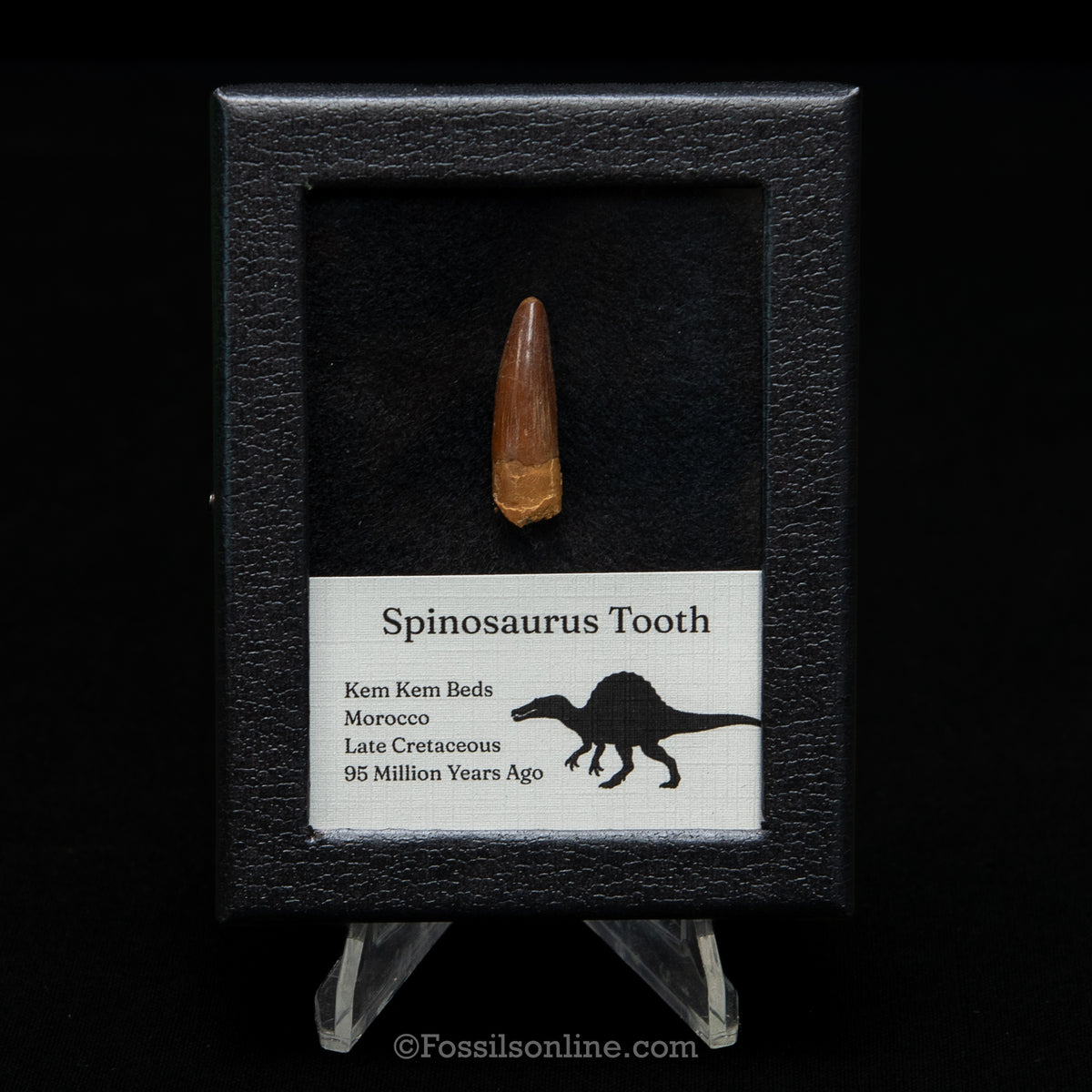
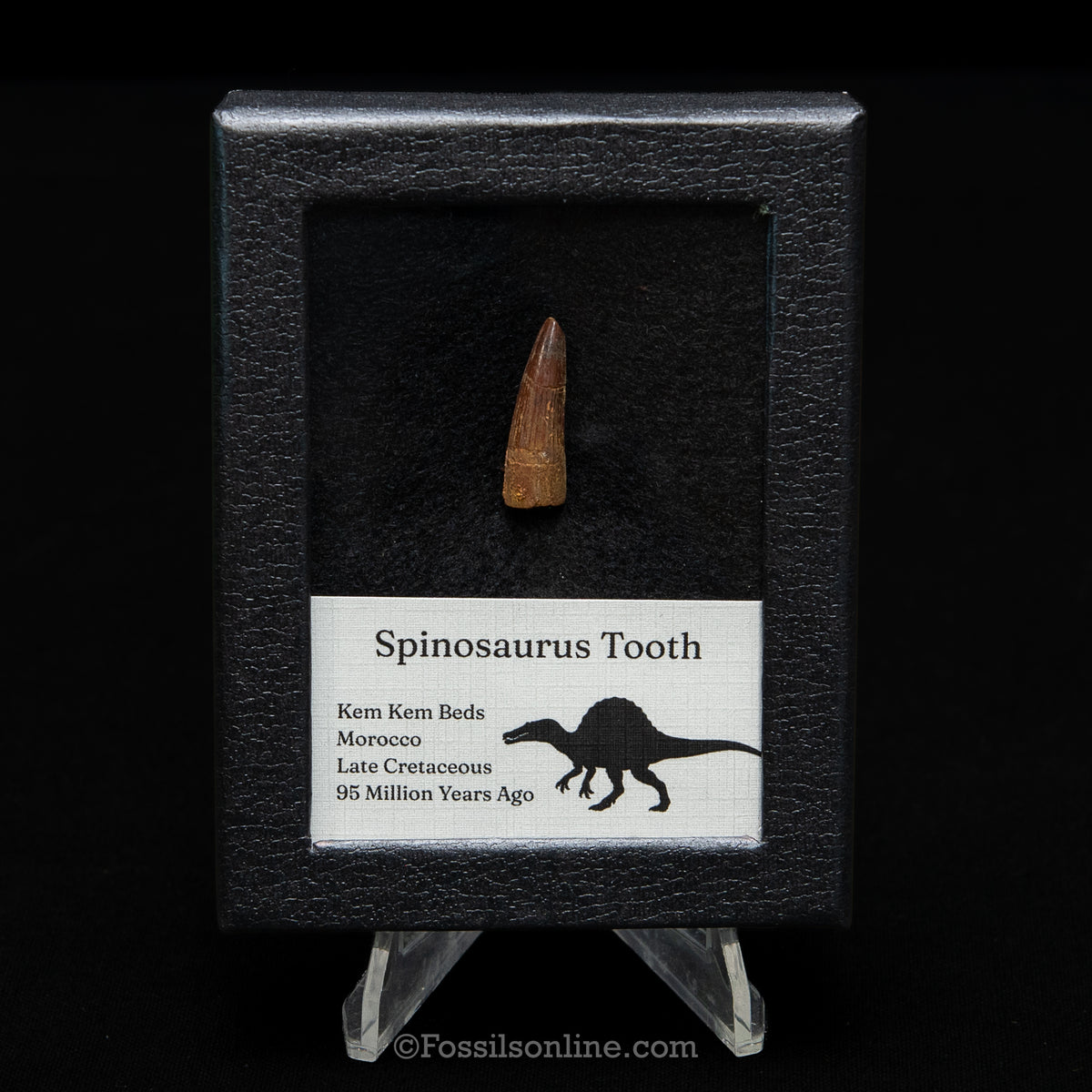
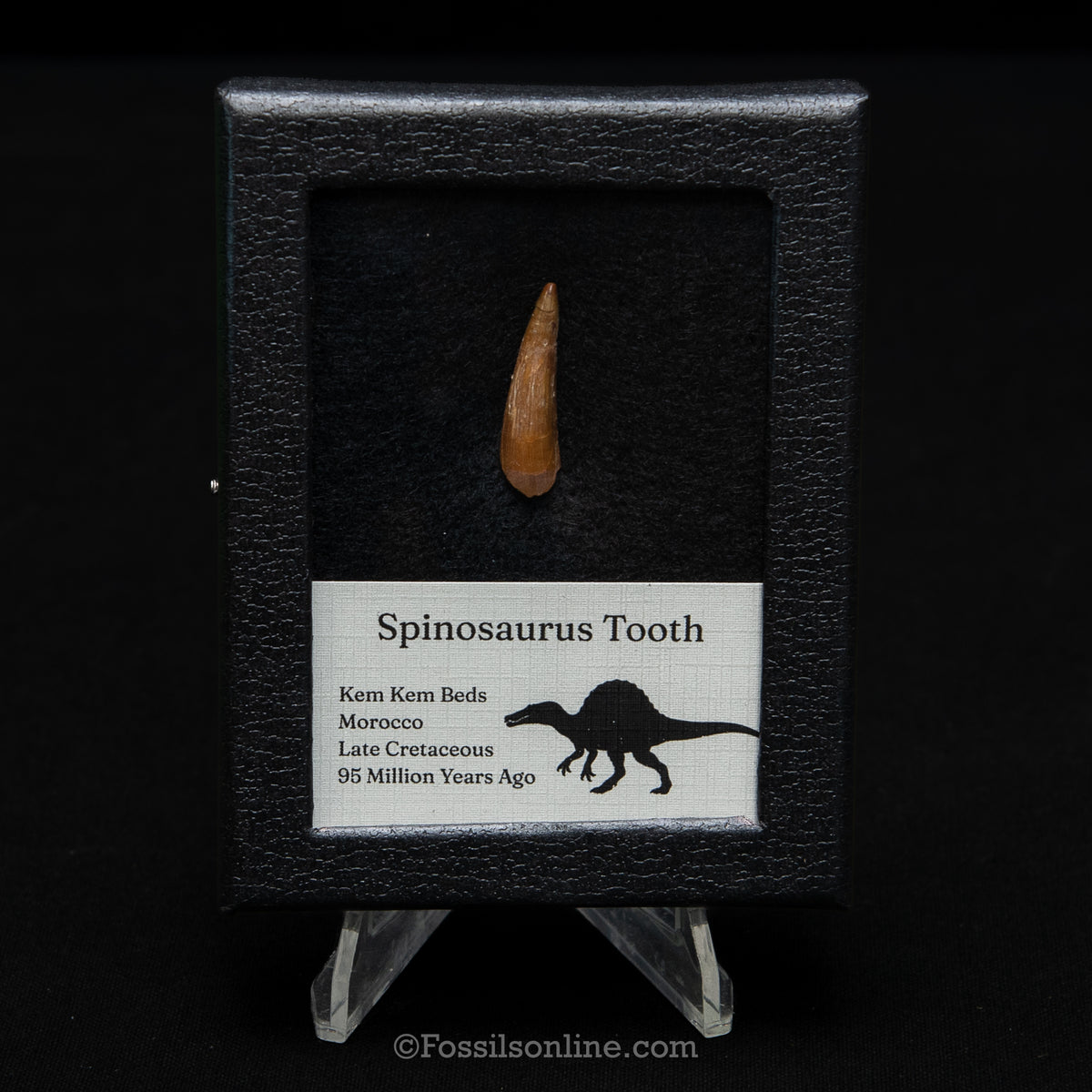
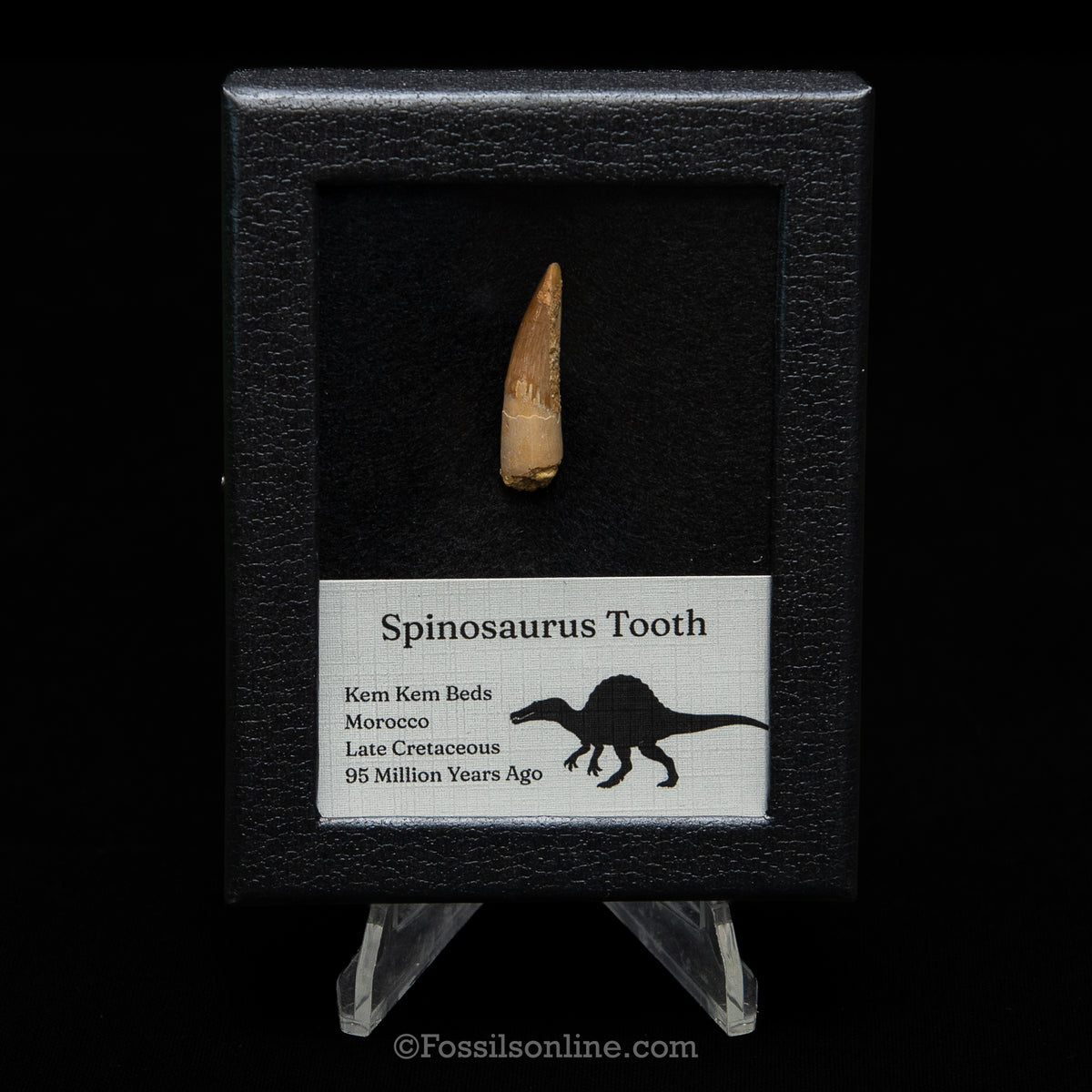
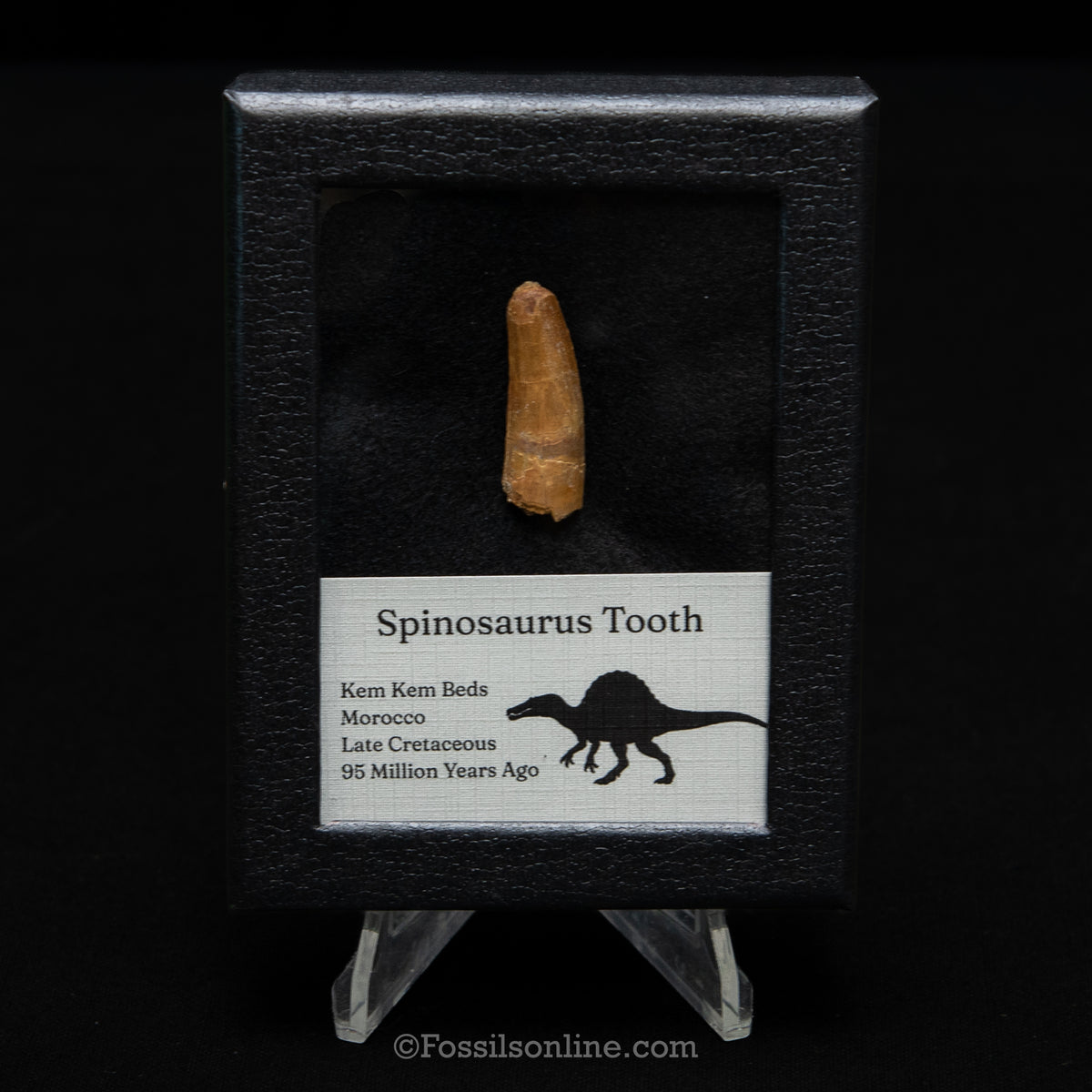
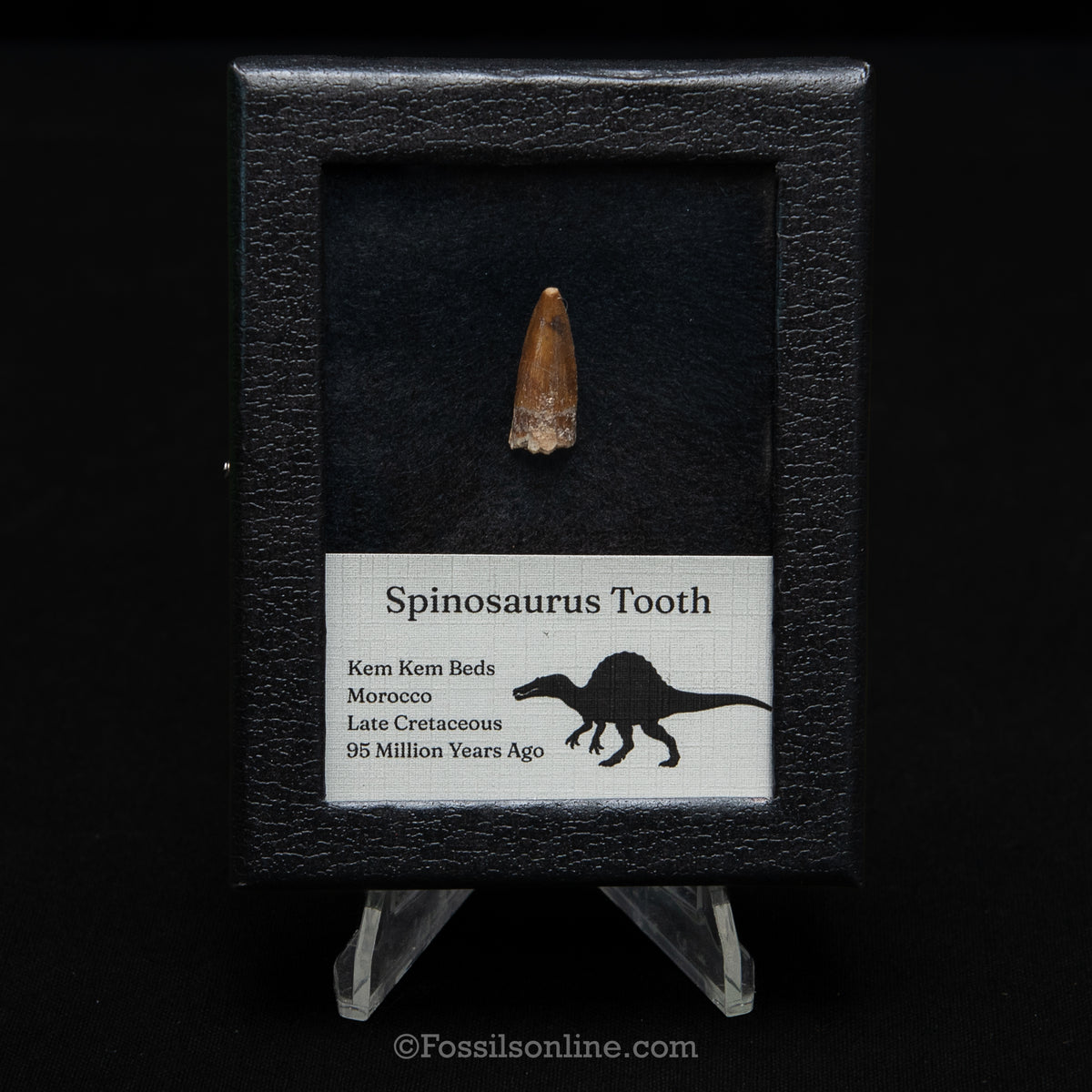
Spinosaurus Dinosaur Tooth Sm Case
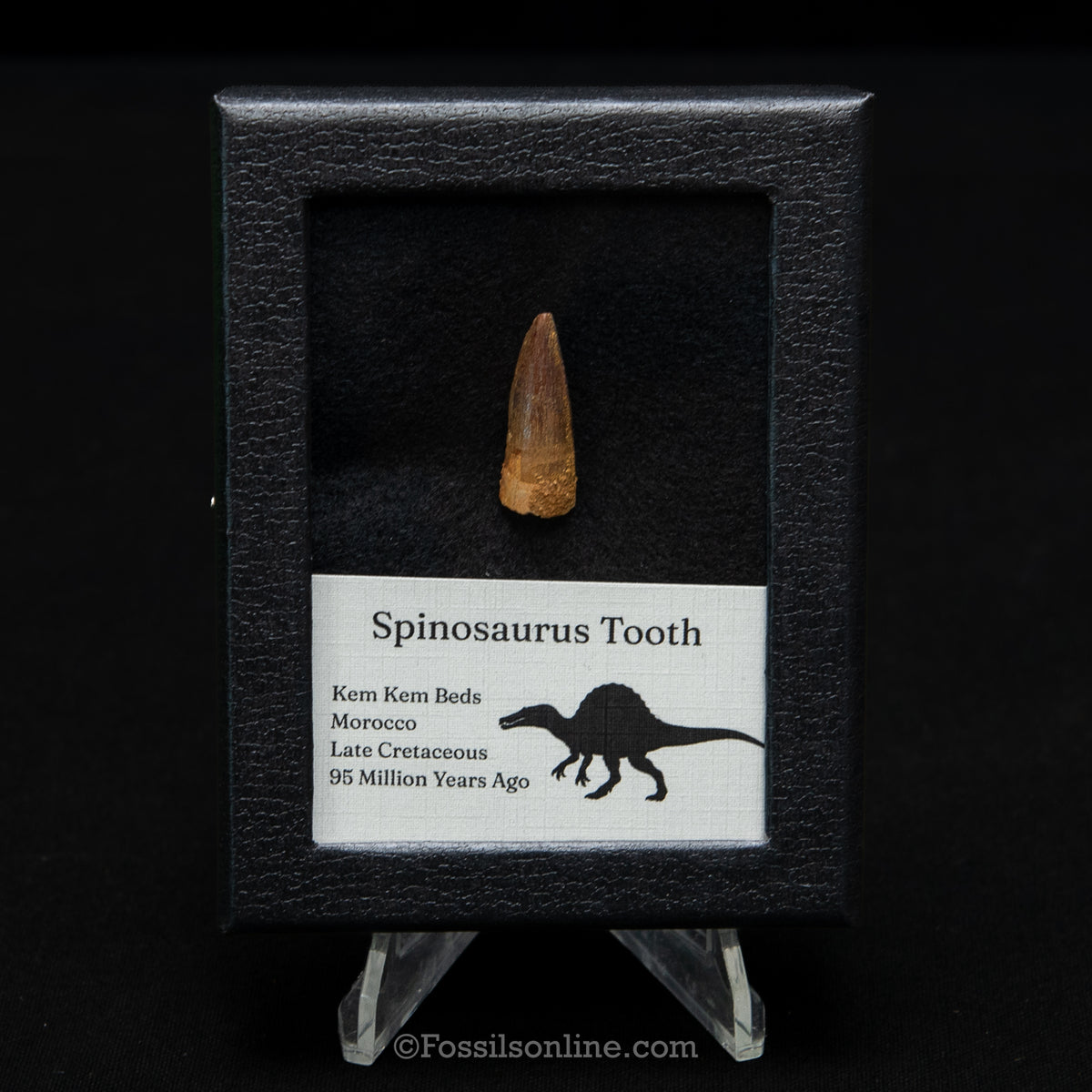
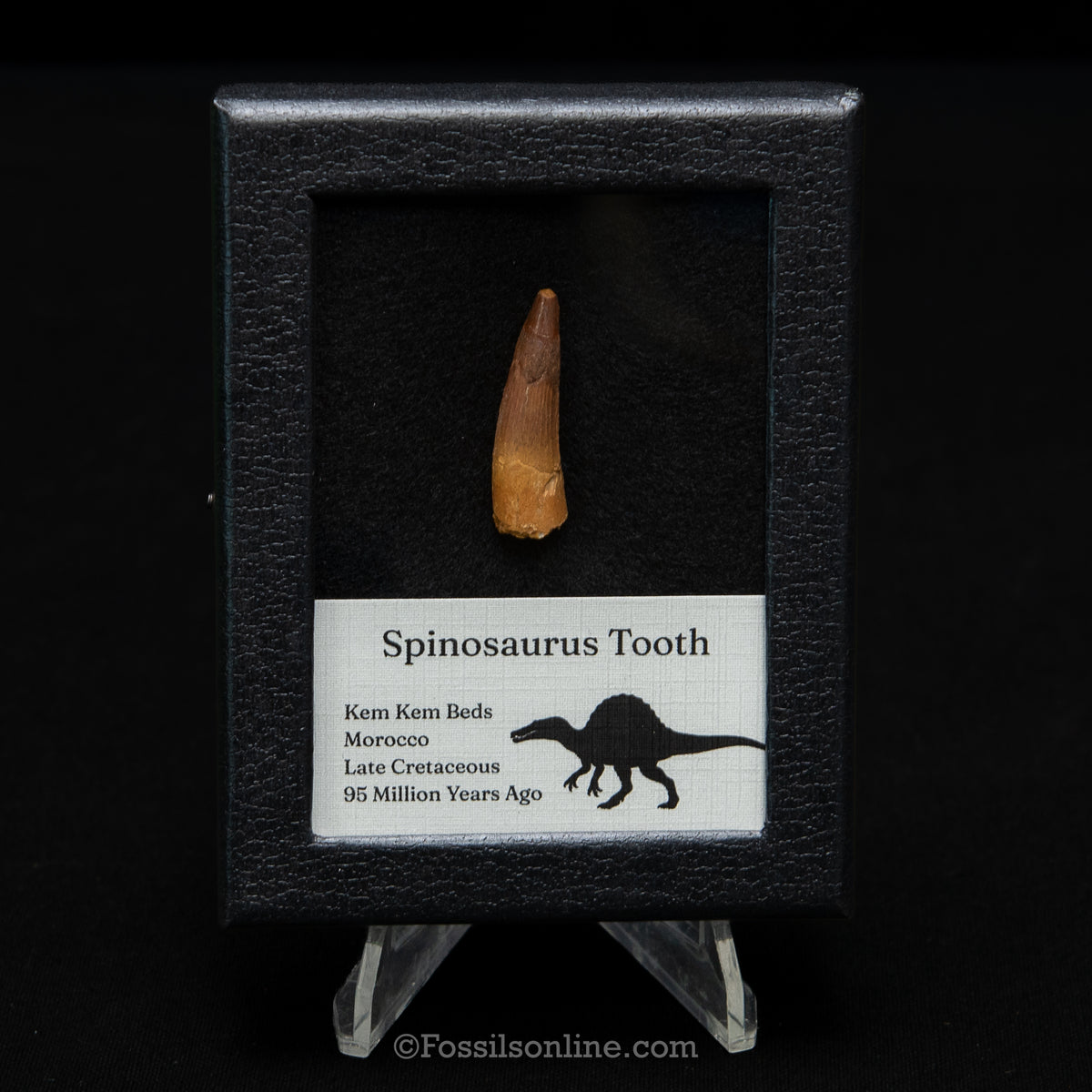
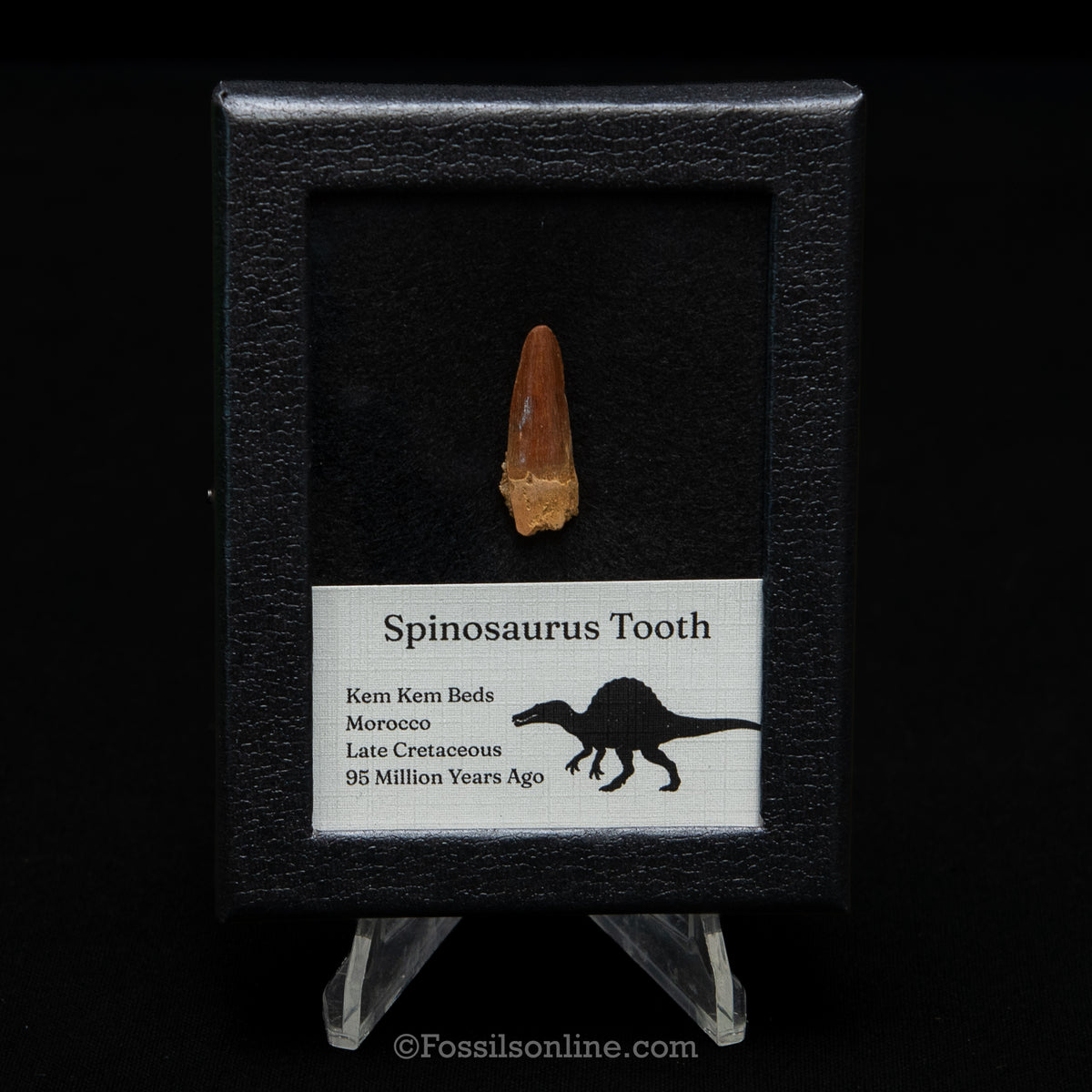
A good-quality Spinosaurus tooth housed in a display box measuring 4.25” x 3.25”.
The price of an item reflects its quality.
The item shown in the picture will be provided to you.
I go through thousands of spinosaur teeth each year and it’s rare to come across a perfect, unbroken tooth.
I’ve picked out some of the better ones. That being said they might have repair and all will have a coating of glue that was applied in the field. I’ve taken good images of them so you can see what I can’t with the naked eye.
Best bang for your buck when it comes to buying a theropod dinosaur tooth…the largest carnivorous dinosaur that ever existed.
Spinosaurus is one of the strangest and most debated dinosaurs ever discovered. This huge predator lived in what is now North Africa during the Late Cretaceous, roughly 100–94 million years ago, in river systems and coastal wetlands that teemed with giant fish, crocodile-like reptiles, and other dinosaurs.
With its long, crocodile-like snout, tall back “sail,” and likely semi-aquatic lifestyle, Spinosaurus doesn’t look or behave like the classic land-stalking meat-eaters most people imagine. It’s a dinosaur that has forced paleontologists to rethink what large theropods could do.
Discovery and the lost type specimen
Spinosaurus was first discovered in Egypt in 1912 and described by German paleontologist Ernst Stromer in 1915. The original fossils came from the Bahariya Formation and included parts of the skull, vertebrae, ribs, and those famous tall neural spines that inspired the name “spine lizard.”
Tragically, Stromer’s original specimen – the holotype – was destroyed during World War II when the Munich museum housing it was hit in an air raid in 1944.
That loss was enormous for science. For decades, all we had were Stromer’s notes, drawings, and a handful of photos. Critical information vanished with the bones: exact proportions, fine details of the spine and skull, and subtle anatomical features that help separate species. Because the type specimen is gone, later fossils from Morocco and elsewhere have had to be compared to old documentation instead of the actual bones. This is a big reason why there’s still debate over how many Spinosaurus species there were, how it was built, and even exactly how big it got.
Size and where it lived
Spinosaurus lived in north African river and delta systems – especially in what’s now Morocco, Egypt, Algeria, and Tunisia – with famous finds from the Kem Kem Beds and the Bahariya Formation. These rocks record a humid, low-lying landscape of rivers, floodplains, and coastal lagoons near the shores of the ancient Tethys Sea.
Most modern estimates put Spinosaurus at about 14–18 meters (46–59 feet) long, making it a strong contender for the longest known theropod dinosaur, rivaling or exceeding Tyrannosaurus rex in length (though probably not in overall bulk). Its weight is debated, but many estimates land in the 7–8+ ton range for the biggest individuals. However you slice it, we’re talking about a massive predator – long, low, and imposing, with a huge sail rising from its back.
How Spinosaurus differed from other big predators
Spinosaurus didn’t look or live like a typical big meat-eater such as T. rex:
-
Crocodile-like skull – Long, narrow snout with conical teeth ideal for gripping slippery prey, more like a huge gharial than a bone-crushing tyrannosaur.
-
Back sail – Very tall neural spines on the vertebrae formed a sail or ridge, possibly used for display, thermoregulation, or species recognition.
-
Shorter hind limbs – Newer fossils suggest shorter, more squat back legs than other giant theropods.
-
Deep, paddle-like tail – Recent discoveries show a tall, fin-shaped tail that could have helped in swimming.
Put together, Spinosaurus seems built less like a sprinting land hunter and more like a semi-aquatic ambush predator, comfortable in the water and at the water’s edge.
Lifestyle – a semi-aquatic specialist
Spinosaurus probably spent much of its life around rivers and wetlands, hunting large fish and other aquatic prey. Evidence for this lifestyle includes:
-
Conical, mostly non-serrated teeth ideal for gripping fish, not sawing through bone like T. rex.
-
Bone structure that appears denser than many other theropods, which may have helped with buoyancy control.
-
The tall, fin-like tail that would provide propulsion in water.
-
An unusually high abundance of Spinosaurus teeth in river deposits, suggesting the animal spent a lot of time in those aquatic settings.
Not everyone agrees it was a fully aquatic dinosaur – some researchers see it more as a wading shoreline predator – but the overall picture is clear: Spinosaurus was tightly tied to water, filling a crocodile-plus niche that no other giant theropod seems to have occupied.
Why Spinosaurus teeth are so common and affordable
If Spinosaurus is such an impressive dinosaur, why are its teeth relatively common and affordable compared to something like T. rex? A few key reasons:
-
Where it lived
Most collectible Spinosaurus teeth come from the Kem Kem Beds of Morocco, a stack of river and delta deposits that are excellent at concentrating and preserving hard parts like teeth. Those same conditions that made great fish and crocodile fossils also produced a lot of Spinosaurus teeth. -
Aquatic lifestyle
Spending so much time in and around water meant every shed tooth had a good chance of dropping straight into a depositional environment where it could be quickly buried and preserved. Over millions of years, that adds up. -
Tooth replacement
Like other theropods, Spinosaurus continually replaced its teeth. A large, fish-hunting predator working river channels daily would lose a huge number of teeth over its lifetime – each one a potential fossil. -
Geology and access
The Kem Kem Beds are actively worked by local collectors and miners, who find and sell large numbers of teeth into the global market. In contrast, T. rex comes from more limited formations in North America with stricter land access and fewer commercial quarries.
Put all that together and you get a dinosaur that’s gigantic and famous, but whose teeth still enter the market in enough volume to keep prices relatively accessible. For many collectors, a Spinosaurus tooth is their first “big theropod” fossil.
How it compares to T. rex and Carcharodontosaurus
Spinosaurus is often compared with two other giant theropods: Tyrannosaurus rex and Carcharodontosaurus(another huge predator from Africa and South America). All three were apex carnivores, but they were built – and lived – very differently.
Tooth shape and feeding style
-
Spinosaurus: long, conical, lightly textured teeth with little or no serration; designed to grip slippery prey like fish and smaller aquatic animals.
-
T. rex: thick, banana-shaped, heavily serrated “bone crusher” teeth built to punch through flesh and bone, delivering devastating bites to large land animals.
-
Carcharodontosaurus: long, laterally compressed, strongly serrated teeth more like enormous steak knives, specialized for slicing through meat rather than crushing bone.
Habitat and hunting
-
Spinosaurus: strongly associated with rivers and wetlands; likely spent much of its time in or near the water, ambushing fish and other aquatic prey.
-
T. rex: a primarily terrestrial predator and scavenger of upland and floodplain environments in North America, targeting large dinosaurs like hadrosaurs and ceratopsians.
-
Carcharodontosaurus: a land-based predator in African ecosystems, probably hunting large herbivorous dinosaurs such as sauropods and iguanodonts.
Collecting and availability
-
T. rex teeth are extremely rare, tightly controlled by locality and land regulations, and carry very high prices.
-
Carcharodontosaurus teeth are more available than T. rex but still significantly scarcer and more expensive than Spinosaurus teeth.
-
Spinosaurus teeth, especially from the Kem Kem Beds, are abundant enough that collectors can often afford a large, impressive tooth for a fraction of what a comparable T. rex or Carcharodontosaurus tooth would cost.
So while all three were giant predators at the top of their food webs, Spinosaurus stands out as the aquatic specialist, with teeth, jaws, and a body plan built for a very different kind of hunting.
The sail – what was it for?
That huge sail on Spinosaurus’ back is one of its most eye-catching features, and scientists still debate its function. Possibilities include:
-
Display and species recognition – a giant visual billboard for attracting mates, intimidating rivals, or signaling to other Spinosaurus.
-
Thermoregulation – a heat-exchange surface helping warm up or cool down the body, though this is still debated.
-
Stability or maneuvering in water – a possible aid in balance and side-to-side stability while swimming or wading.
Whatever its exact purpose, the sail makes Spinosaurus instantly recognizable and adds to its appeal in both science and collecting.
A constantly changing dinosaur
One of the most interesting things about Spinosaurus is how fast our picture of it has changed.
-
Early reconstructions showed a fairly typical big theropod with a sail.
-
Later versions gave it a more classic “T. rex-like” stance.
-
Recent discoveries – especially the shorter legs and paddle-like tail – now suggest a long-bodied, semi-aquatic animal very different from what most people grew up seeing.
For collectors and dinosaur fans, that means owning a Spinosaurus tooth is owning a piece of a story that’s still unfolding. As new fossils come out of North Africa and new studies are published, our understanding of this bizarre predator continues to evolve.
Why people love collecting Spinosaurus
Spinosaurus hits a sweet spot for collectors:
-
It’s one of the largest carnivorous dinosaurs ever discovered.
-
It has a wild, unique look – sail, crocodile snout, semi-aquatic lifestyle.
-
Its teeth are common enough and affordable enough that many people can actually own a piece of it.
-
New discoveries keep it in the spotlight, so it’s a dinosaur that feels “alive” in current research, not just a static museum classic.
Whether it’s a single tooth from the Kem Kem Beds or a larger piece of bone, a Spinosaurus fossil connects you directly to a giant, sail-backed predator that prowled Cretaceous rivers long before the first T. rex ever walked the Earth.
Species
Spinosaurus sp.
AGE
Cretaceous
LOCATION
Kem Kem Basin, Morocco
Size
.85"-1.25"
Choose options