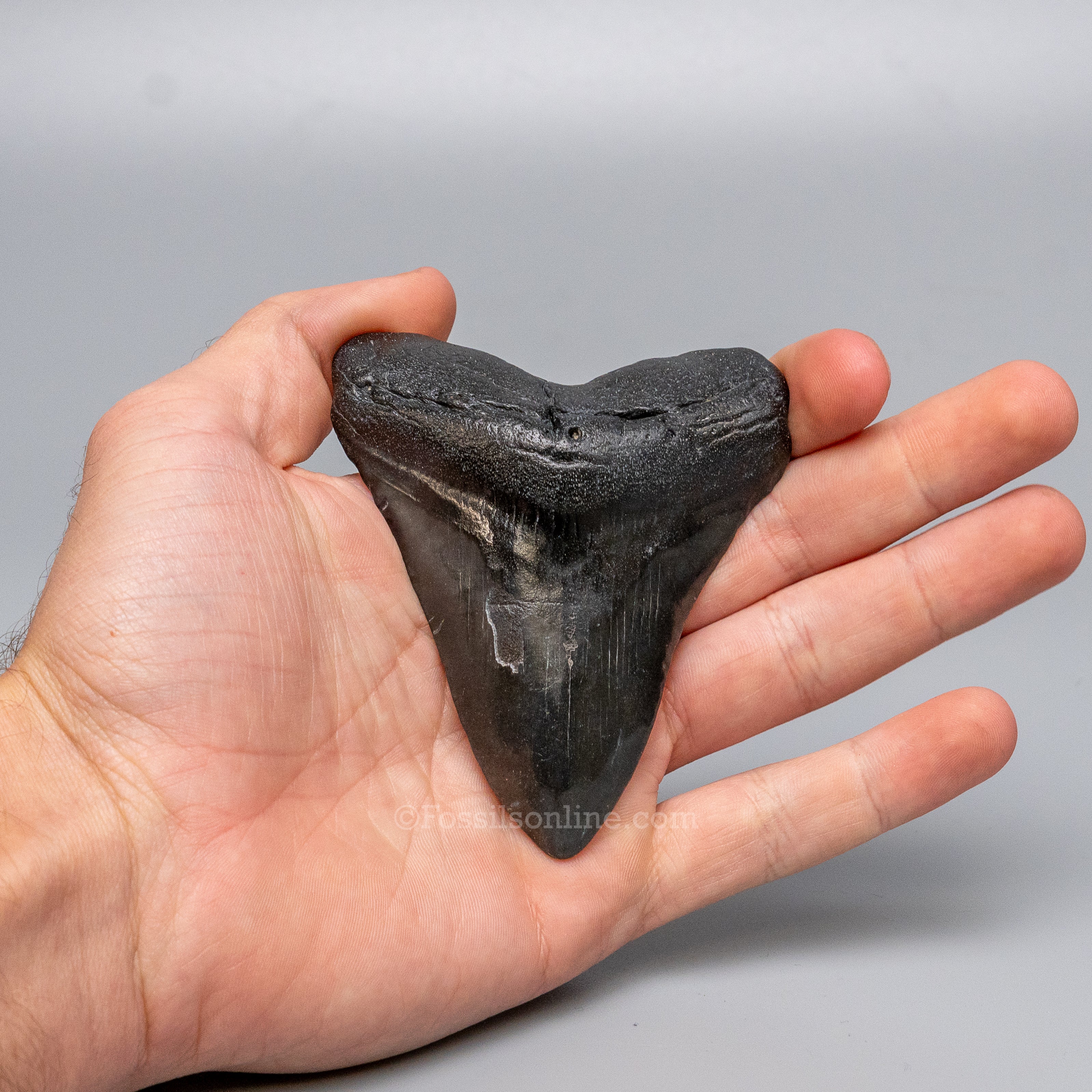
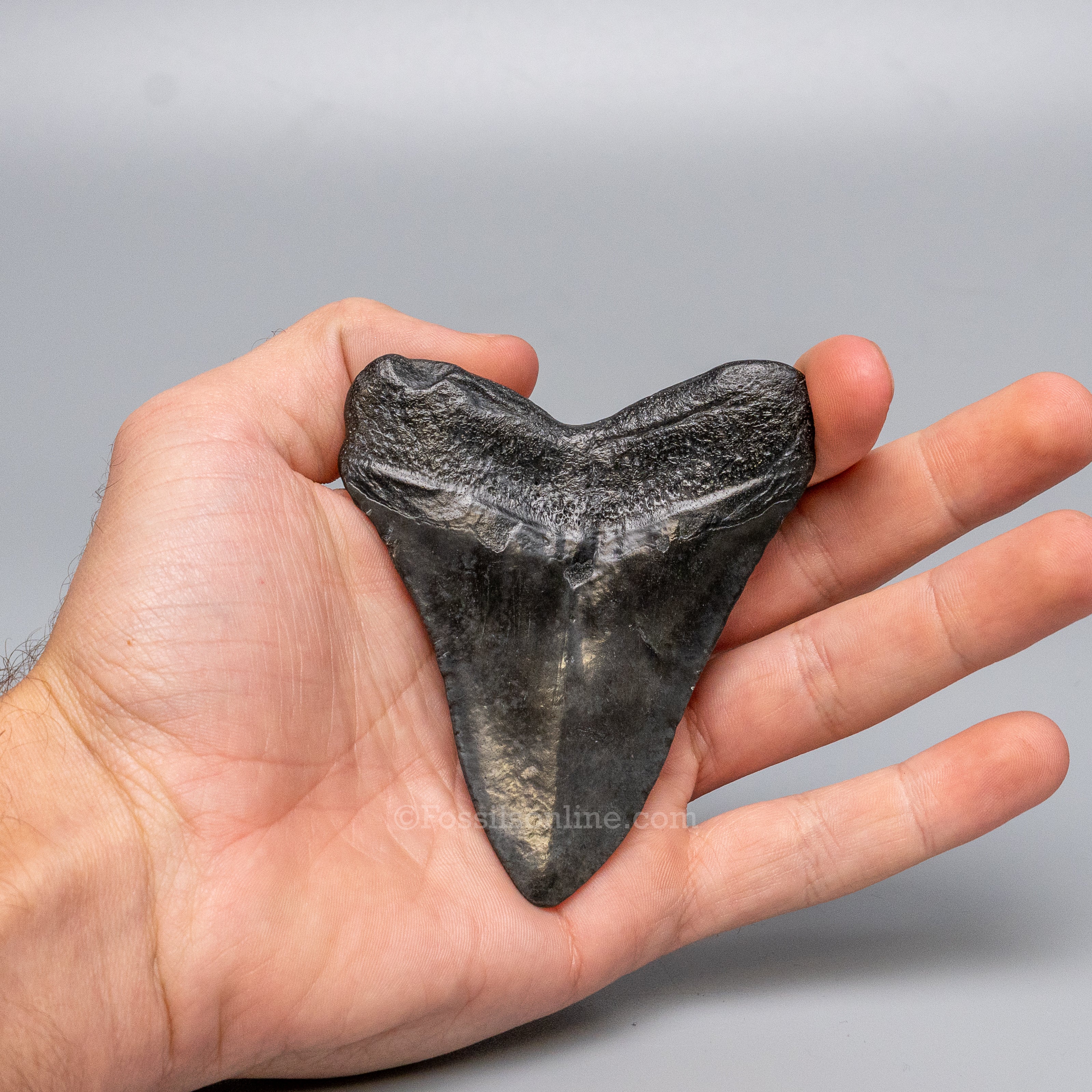
South Carolina Megalodon 3.51"
nice tooth with a symmetrical shape, and glossy black enamel.
Why so many Megalodon teeth come from offshore South Carolina?
The coast of South Carolina is one of the most productive Megalodon tooth localities anywhere, especially for deep, rich black teeth. Offshore of today’s beaches lies a wide continental shelf cut by ancient river channels and ledges where fossil-bearing sediments are exposed. These sediments include Miocene and Pliocene marine deposits that were once warm, shallow seas—prime hunting grounds for Megalodon and the whales and marine mammals it fed on. As those animals lived, fed, and died in these waters, their hard parts—especially teeth—were buried in the seafloor sediments and protected for millions of years.
Over time, sea-level changes, storms, and currents have stripped some of those protective layers away, revealing fossil-rich ledges in 80–120+ feet of water off the South Carolina coast. Commercial fishing trawlers, dredging operations, and scuba divers working those drops and “live bottom” areas regularly encounter Megalodon teeth lying in or just above the hard bottom. Many of the most impressive jet-black Megalodon teeth on the market today are labeled “offshore South Carolina” for exactly this reason: the right age rocks, the right ancient habitat, accessible depths, and a long history of boats working these areas combine to make it a steady producer of large, well-preserved teeth year after year.
Why Megalodon teeth are so attainable
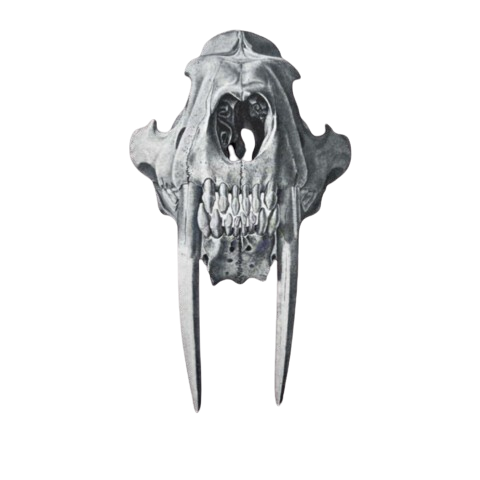
One of the reasons black offshore South Carolina Megalodon teeth are so popular is that they sit in a unique sweet spot for collectors: dramatic, impressive fossils that still remain relatively attainable. You get that “museum fossil” punch without needing a museum budget. When most people think of fossils, they picture complete dinosaur skeletons or famous Ice Age mammals like sabertooth cats and mammoths. Those fossils are rare, tightly controlled, and often expensive even in small fragments. By comparison, a big South Carolina Megalodon tooth—especially a black offshore specimen—delivers serious visual impact for a fraction of the cost of a comparable “headline” dinosaur or Ice Age fossil. A single large tooth has presence, weight, and instant recognizability, even to someone who doesn’t know much about paleontology. Shark biology is a big part of this. Megalodon, like modern sharks, constantly shed and replaced its teeth throughout its life. A single animal could produce thousands of teeth, each one with a chance to be buried and fossilized. Those teeth are heavily mineralized and built to withstand crushing bites, so they hold up through burial, reworking, and millions of years on the seafloor far better than most bones. Add to that the geography of South Carolina. Megalodon lived in warm coastal seas, and those ancient marine sediments are now exposed along offshore ledges, in dredge spoil, and in areas divers can actually reach. Many dinosaur and Ice Age carnivore localities, on the other hand, are remote, protected, or tightly regulated, which limits how much material ever makes it to the open market.
All of this means high-quality Megalodon teeth—especially offshore South Carolina specimens—enter the collector market more often than complete Ice Age skeletons or nicely preserved dinosaur bones. They’re still true fossils of one of Earth’s most impressive predators, but they remain within reach of real-world budgets. For roughly what you might spend on a small dinosaur tooth or a single Ice Age bone, you can often step up to a big, display-worthy Megalodon tooth with genuine size, weight, and presence.
How Megalodon got so large
Megalodon’s huge size wasn’t an accident; it was the result of several advantages working together:
High-energy physiology (partially warm-blooded). Evidence from tooth and tissue microstructure suggests Megalodon could keep parts of its body warmer than the surrounding water, similar to some modern sharks like great whites and makos. That boosted metabolism supported fast growth and the power needed to move a massive body through the water. During the Miocene and Pliocene, the oceans were packed with whales and other large marine mammals. Specializing in big, calorie-rich prey allowed Megalodon to “afford” its size—each successful hunt delivered a huge energy payoff, favoring bigger, stronger individuals over millions of years.
Efficient, cruising body design
Recent research suggests Megalodon may have had a more elongated, hydrodynamic body than the chunky, overly bulky reconstructions you sometimes see. A sleeker shape would reduce drag, making it easier for a giant shark to cover long distances, patrol coastlines, and search out concentrations of prey.
Why we find teeth, not skeletons
Cartilage doesn’t fossilize well. Sharks have skeletons made mostly of cartilage, not dense bone. After death, that cartilage breaks down quickly and usually vanishes before mineral-rich water can replace it. Only small pieces of vertebrae or hardened areas sometimes fossilize.
Teeth are built to survive
Megalodon teeth are thick, heavily mineralized, and coated in hard enamel. They were designed to withstand crushing impacts on bone and tough connective tissue, so they can also withstand burial, transport, and even tumbling around the seafloor. Like modern sharks, Megalodon constantly shed teeth and replaced them with new ones. A single shark could produce thousands over its lifetime, and every one had a chance to become a fossil.
Put together, that’s why teeth are by far the most common Megalodon remains. Vertebrae and other fragments show up occasionally, but the iconic triangular teeth are what fill collections, museum displays, and jewelry cases all around the world.
Megalodon’s disappearance
Megalodon dominated the oceans for roughly 15 million years before disappearing around 3.6 million years ago. Scientists are still piecing together the exact cause, but a few major factors are likely involved:
-
Cooling oceans as global climates shifted, shrinking the warm-water zones Megalodon preferred.
-
Changes in prey, as whale species evolved, diversified, or altered their migration routes, potentially reducing reliable food sources.
-
New competition from emerging predators such as early great white sharks and toothed whales (including ancestors of modern orcas), which may have targeted similar prey or hunted Megalodon juveniles.
By the time humans ever walked along what is now the South Carolina coastline, Megalodon had been extinct for millions of years. The black teeth divers and trawlers bring up today are ancient leftovers from a predator long gone.
Color, preservation, and the “look” of black offshore South Carolina teeth
Collectors can often pick out a black offshore South Carolina tooth at a glance. These teeth tend to show a distinctive, darker palette shaped by the chemistry of the sediments and the long time they’ve spent on the seafloor. Instead of the creams, tans, and blue-greys that are common in some North Carolina localities, offshore South Carolina Megalodon teeth are famous for their black and charcoal tones. Enamel can range from glossy jet-black to smoky gray, sometimes with subtle brown or steel-blue undertones. Roots are usually deeply mineralized—dark gray to black—and can feel very dense and “heavy” in the hand. On many specimens, the darker roots and crown make the bourlette (the band between the root and enamel) stand out with extra contrast.
Years in moving water leave their mark. Some offshore teeth are worn smooth by sand and current, giving them a slick, polished look that many collectors find especially attractive. Others retain crisp, saw-like serrations and sharp tips, showing that not every tooth spent the same amount of time rolling around on the bottom.
Because each tooth spent millions of years in its own micro-environment—different positions in the sediment, slightly different chemistry, different histories of exposure and reburial—no two black South Carolina Megalodon teeth look exactly alike. The color, sheen, and wear pattern you see on a given specimen are part of its individual story: pulled from dark, phosphate- and iron-rich sediments off the Carolina coast, and now ready to be held and displayed as a very real piece of the largest predatory shark that ever lived.
LOCATION
South Carolina
Size
3.51"
Choose options