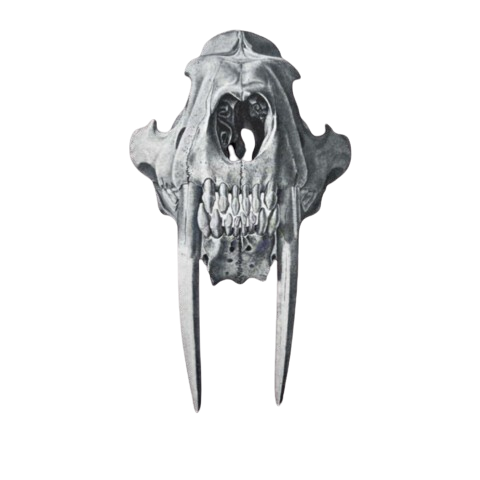


Cave Bear Jaw with Stand
Beautiful Cave Bear jaw with an impressive composite canine showing beautiful preservation. it appears some of dentition has also been composited with very accurate teeth. overall this jaw is very well preserved with beautiful teeth. product measures 8.2" X 7.7" on stand.
Display stand included.
Cave Bear (Ursus spelaeus)
The cave bear (Ursus spelaeus) was one of the most impressive mammals of the Ice Age, a gigantic prehistoric relative of today's brown bear, with an enormous skull, powerful jaws, massive teeth, and a heavily built body. It roamed across Europe during the Pleistocene Epoch, sharing the landscape with woolly mammoths, woolly rhinoceroses, cave lions, cave hyenas, and early humans. Some of the most important cave bear fossil discoveries have come from Romania, particularly the spectacular cave systems of the Carpathian and Apuseni Mountains.
Cave bears lived primarily during the Middle and Late Pleistocene, with many of the best-known Romanian specimens dating to approximately 50,000–30,000 years ago. The species eventually became extinct around 24,000–26,000 years ago, during the harsh climatic conditions of the Last Glacial Period.
For collectors, a cave bear jaw is a particularly impressive piece of Ice Age megafauna. Unlike an isolated tooth or small bone fragment, a jaw preserves an important part of the animal's feeding anatomy, including its powerful dental structure and characteristic ursid proportions. It represents a direct physical connection to one of the largest bears ever to walk the European continent.
Discovery and scientific importance
Cave bear remains have been known from European caves for centuries, but scientific research has gradually transformed our understanding of these animals.
Romania has played an important role in this research. The discovery and excavation of Peștera cu Oase in the early 2000s revealed an extraordinary accumulation of cave bear bones alongside some of Europe's oldest known early modern human remains.
One particularly interesting aspect is that cave bears frequently accumulated in caves where they spent the winter hibernating. Many individuals likely died naturally inside these underground shelters, resulting in substantial concentrations of skeletal material over thousands of years.
Research into Romanian cave bear populations has also revealed interesting information about their final generations. Radiocarbon studies indicate that the Carpathian region remained an important habitat for cave bears surprisingly late into the last glacial period.
Size, build, and physical characteristics
The cave bear was an exceptionally large member of the bear family, with some individuals considerably exceeding the size of modern brown bears.
Approximate physical characteristics included:
- Body length: Around 2.5–3 meters for large individuals.
- Standing height: Could approach 3 meters when standing upright.
- Weight: Commonly estimated at several hundred kilograms, with exceptionally large individuals potentially exceeding 1,000 kg.
- Skull: Massive and heavily constructed, with a prominent forehead and powerful jaw musculature.
- Dentition: Large cheek teeth adapted primarily for processing plant material, alongside the characteristic canine teeth of bears.
Cave bears possessed a distinctive skeletal structure, with a broad skull, robust limbs, and a heavily built body. Their proportions were different from those of many living bear species, reflecting their particular evolutionary adaptations.
They inhabited much of Europe, from western regions through central and eastern Europe, including the mountainous landscapes of modern-day Romania.
what did cave bears eat?
For many years, cave bears were considered predominantly herbivorous animals. Their skull proportions and dental anatomy suggested an animal heavily adapted to processing vegetation rather than regularly hunting large prey.
Their diet likely included:
- Grasses and other vegetation.
- Leaves and roots.
- Berries and fruits.
- Seeds and hard-shelled plant material.
- Other available food sources depending on the season.
However, more recent research has revealed a more complicated picture.
A 2024 study examining dental microwear in Romanian cave bears found evidence of omnivorous feeding behavior, particularly before hibernation. The research identified wear patterns consistent with the consumption of hard food items, including potentially seeded fruits.
This suggests that cave bears were more flexible feeders than previously assumed.
Their enormous size meant that they required substantial food resources, and seasonal changes would have played an important role in their survival.
What made the cave bear different from modern bears?
Although cave bears belonged to the same general family as modern brown bears, they developed several distinctive anatomical characteristics.
Massive skull and powerful jaws
The cave bear possessed an exceptionally large skull, with strong jaw muscles and substantial chewing surfaces. Its skull was particularly adapted for processing tough vegetation and other food sources.
Distinctive cheek teeth
One of the most recognizable features of cave bears is their large, broad cheek teeth. Their molars and premolars had relatively expanded grinding surfaces, reflecting their predominantly plant-based feeding habits.
Powerful canine teeth
Like modern bears, cave bears possessed prominent canine teeth. These were important anatomical features and gave the animal an imposing appearance.
Robust skeletal structure
Cave bears were heavily built animals, with powerful limbs and a substantial skeletal framework. Their large bodies were well adapted to surviving in the challenging environments of Pleistocene Europe.
Specialized skull proportions
The cave bear skull was particularly distinctive, with a pronounced forehead and different cranial proportions compared with those of modern brown bears. These characteristics help paleontologists distinguish cave bear remains from other fossil ursids.
The extinction of the cave bear
The disappearance of the cave bear is one of the major extinction events associated with the Late Pleistocene megafauna.
Unlike some other prehistoric bears, cave bears were particularly dependent on plant-based food resources. As the climate deteriorated during the Last Glacial Period, vegetation became less available across many parts of Europe.
This placed increasing pressure on populations that required substantial quantities of food to survive and prepare for winter hibernation.
Several factors have been investigated as possible contributors to their extinction:
Climate change
The increasingly cold conditions of the Last Glacial Period altered vegetation patterns and reduced the availability of suitable food in many regions.
Habitat changes
Changing environmental conditions affected the availability of suitable feeding and hibernation habitats.
Competition and human activity
Early modern humans increasingly occupied parts of Europe, including cave environments also used by cave bears. Human activity may have added further pressure to already vulnerable populations.
Specialized feeding requirements
Their substantial dependence on vegetation may have made cave bears particularly vulnerable to major environmental changes.
The species disappeared approximately 24,000–26,000 years ago, leaving behind an extraordinary fossil record preserved in caves throughout Europe.
Romania's Carpathian cave systems have provided some of the most important evidence for understanding this final chapter.
Species
Ursus spelaeus
AGE
Pleistocene
Size
8.2"x4.7"
Choose options