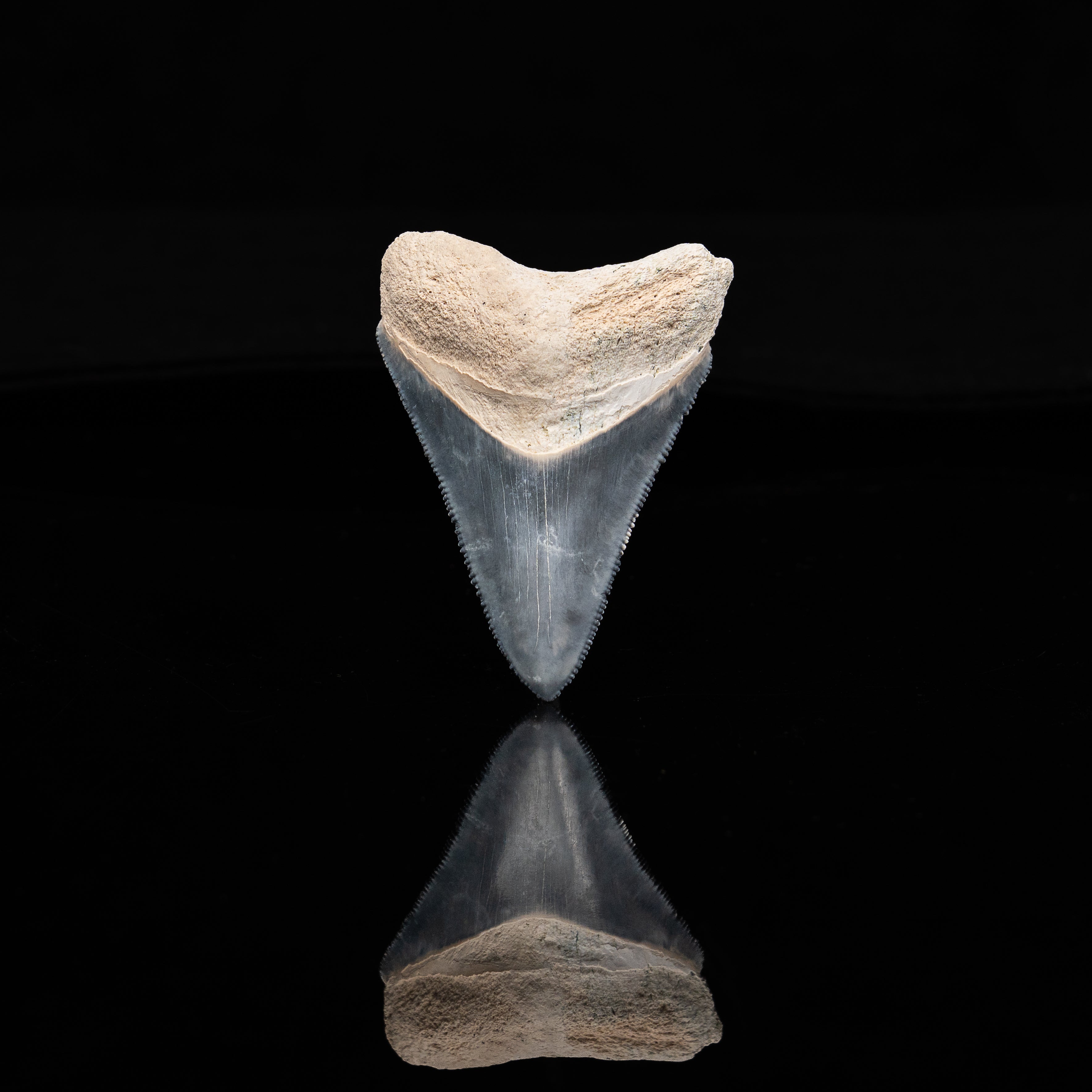
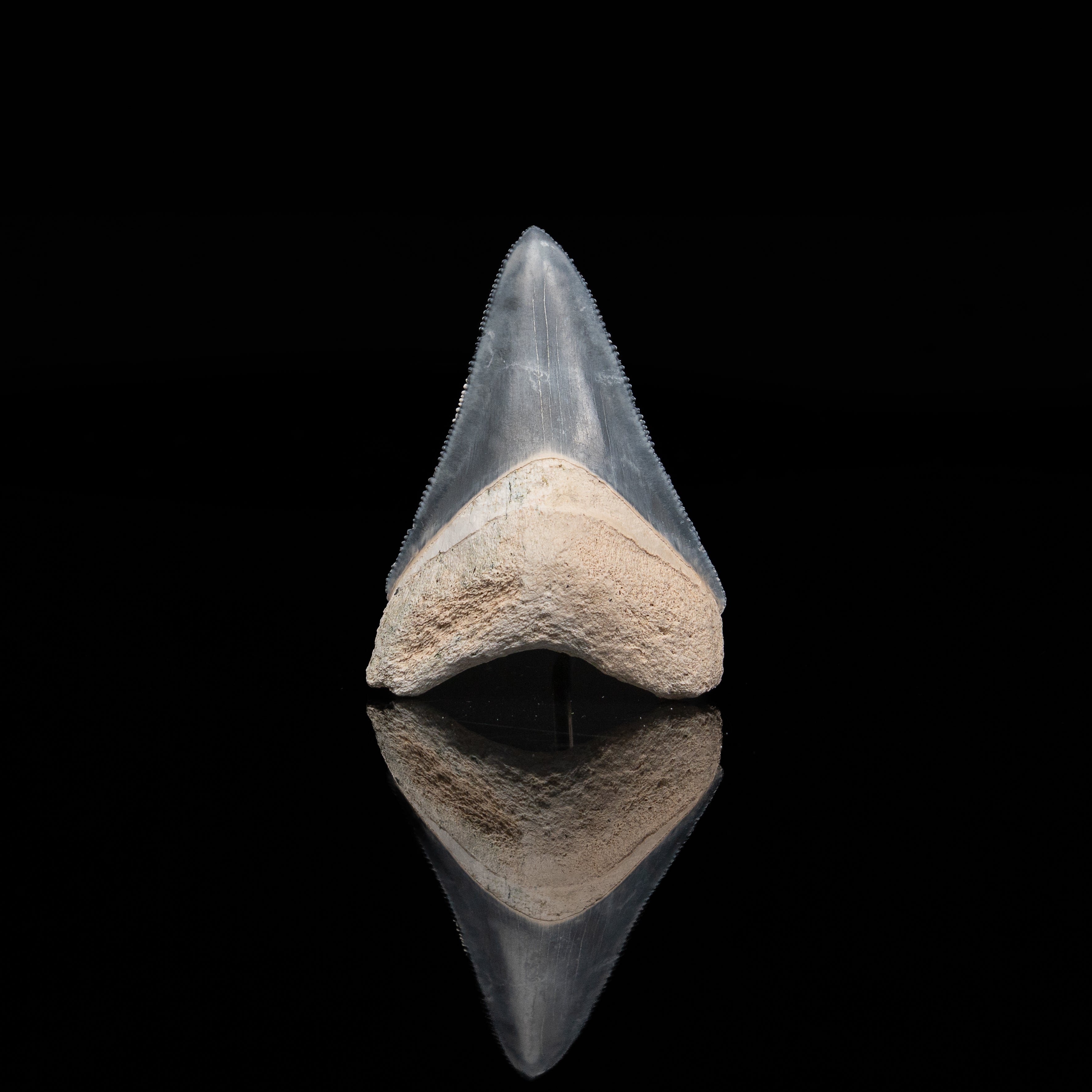

Bone Valley Megalodon 2.27"
This beautiful megalodon isn't perfect, it has minor wear and tear from millions of years in the ground. It has beautiful dark blue enamel and a solid, white root. It also phosphoresces under UV light due to high amounts of phosphatic minerals and other trace elements that hold UV energy and re-release it as visible light.
Otodus megalodon
Otodus megalodon is the largest predatory shark ever known, living from the Miocene into the Pliocene, roughly 23 to 3.6 million years ago. It reached estimated lengths of 50–60 feet or more, making it one of the most powerful marine predators in Earth’s history.
Megalodon occupied oceans worldwide and sat at the very top of the food chain, preying on large marine animals and shaping entire ecosystems.
Diet and habitat
Megalodon lived in warm, coastal and offshore waters across the globe. Fossils have been found on every continent except Antarctica, showing just how widespread it was.
Its diet consisted primarily of:
- Whales and other marine mammals
- Large fish
- Smaller sharks
Its massive size and strength allowed it to hunt some of the largest animals of its time. Bite marks on fossil whale bones show clear evidence of powerful attacks, often targeting flippers, ribs, and tails to disable prey.
Tooth morphology compared to other sharks
Megalodon teeth are among the most recognizable fossils in the world. They are large, triangular, and built for maximum cutting power.
Key features include:
- Thick, broad crowns designed to withstand extreme bite forces
- Fully serrated edges for slicing through flesh and bone
- A distinct bourlette (the darker band between root and enamel)
- Massive roots to anchor the tooth during powerful bites
Compared to other sharks:
- The modern Carcharodon carcharias has similar serrated teeth but much smaller and less robust
- Carcharodon hastalis has smooth-edged teeth for slicing, lacking serrations entirely
- Megalodon’s teeth combine size, serrations, and thickness to create a true bone-cutting tool
These teeth were not just for slicing—they were capable of crushing bone and delivering devastating bites.
Evolutionary importance
Otodus megalodon belongs to the megatooth shark lineage, which evolved increasingly large, serrated teeth over time. Earlier relatives had smoother edges, but as prey grew larger and tougher, serrations developed to improve cutting efficiency.
Megalodon represents the peak of this evolutionary trend—a fully specialized apex predator built to hunt large marine mammals.
Why we mostly find teeth
Like all sharks, Megalodon had a skeleton made primarily of cartilage, which does not preserve well over long periods. Teeth, however, are highly mineralized and extremely durable.
Megalodon continuously replaced its teeth throughout its life, producing thousands over time. Each tooth had the potential to be fossilized, which is why teeth are by far the most common remains found today.
Color and preservation
Megalodon teeth come in a wide range of colors depending on the minerals present in the surrounding sediment during fossilization.
Common colors include:
- Black and gray from phosphate-rich deposits
- Tan and brown from sandy environments
- Blue or green in rarer mineral conditions
Some teeth are heavily worn from movement in sediment, while others retain sharp serrations and pristine tips. Each tooth reflects its own history of burial, exposure, and preservation, making every specimen unique.
What is Bone Valley?
Bone Valley is one of the most famous fossil-producing regions in the United States, located in central Florida. It’s not a single quarry, but a broad area within the Bone Valley Formation, primarily in Polk, Hillsborough, and surrounding counties.
The name “Bone Valley” comes from the incredible abundance of fossil material found there—especially bones and teeth from marine animals. For over a century, the region has been mined for phosphate, and in the process, it has produced one of the richest concentrations of Miocene–Pliocene fossils in North America.
Why Bone Valley fossils are so collectible
Bone Valley sits in a unique position for collectors—it offers high-quality fossils with real scientific significance, while still being obtainable compared to many other famous fossil localities.
Key reasons include:
Phosphate preservation – The fossils are heavily mineralized, often dense and durable, which helps preserve fine detail like serrations on shark teeth.
Diverse species – Fossils include a wide range of marine life, especially sharks like Otodus megalodon, Hemipristis serra, and many others.
Strong visual appeal – Bone Valley fossils are known for their darker colors—blacks, grays, and deep browns—which give them a bold, display-worthy look.
Historical importance – The region has been studied and collected for generations, making it a cornerstone of North American fossil collecting.
Even though large quantities of material have been recovered over time, high-grade specimens—sharp, complete, and minimally worn—are still highly sought after.
Age and environment
The Bone Valley Formation dates primarily to the Miocene and Pliocene epochs, roughly 5 to 20 million years ago.
At that time, much of Florida was submerged under a warm, shallow sea. This environment supported:
- Large predatory sharks
- Rays and bony fish
- Marine mammals
- Occasional terrestrial animals washed out to sea
Over time, layers of sediment rich in phosphate built up on the seafloor, burying and preserving remains in remarkable detail.
What makes Bone Valley fossils unique
Bone Valley fossils stand out for a few key reasons:
Heavy mineralization
Fossils are often unusually dense due to phosphate replacement, giving them a solid, almost stone-like feel.
Dark coloration
Most specimens range from gray to jet black, sometimes with hints of blue or brown. This coloration comes from the chemistry of the surrounding sediments.
Surface texture
Some fossils are smooth and polished from natural movement in sediment, while others retain crisp edges and fine details.
Mixed environments
While primarily marine, some fossils show evidence of transport, meaning material from different environments can end up preserved together.
Color rarity and collector appeal
Color plays a huge role in Bone Valley fossil desirability, especially with shark teeth.
- Blue coloration – Highly sought after and far less common than standard black or gray. Blue tones can range from soft slate to deeper steel-blue hues and are prized for their uniqueness and visual appeal.
- Green coloration – Considered a true “holy grail” among collectors. Green Bone Valley teeth are extremely rare and often command significant attention when they appear. The color likely comes from specific mineral conditions during fossilization that only occur in very limited circumstances.
Because each fossil forms in its own micro-environment, these unusual colors are unpredictable—making blue, orange and especially green specimens some of the most desirable pieces from the region.
Shark teeth from Bone Valley
Shark teeth are the most iconic fossils from Bone Valley. Species commonly found include:
- Otodus megalodon
- Hemipristis serra
- Various requiem and tiger sharks
These teeth are often:
- Thick and well-preserved
- Dark in color, sometimes with rare blue or green hues
- Either smoothly worn or sharply serrated depending on their history
Because sharks constantly replaced their teeth, the fossil record is especially rich in these specimens.
AGE
Miocene-Pliocene
LOCATION
Bone Valley, FL
Size
2.27"
Choose options