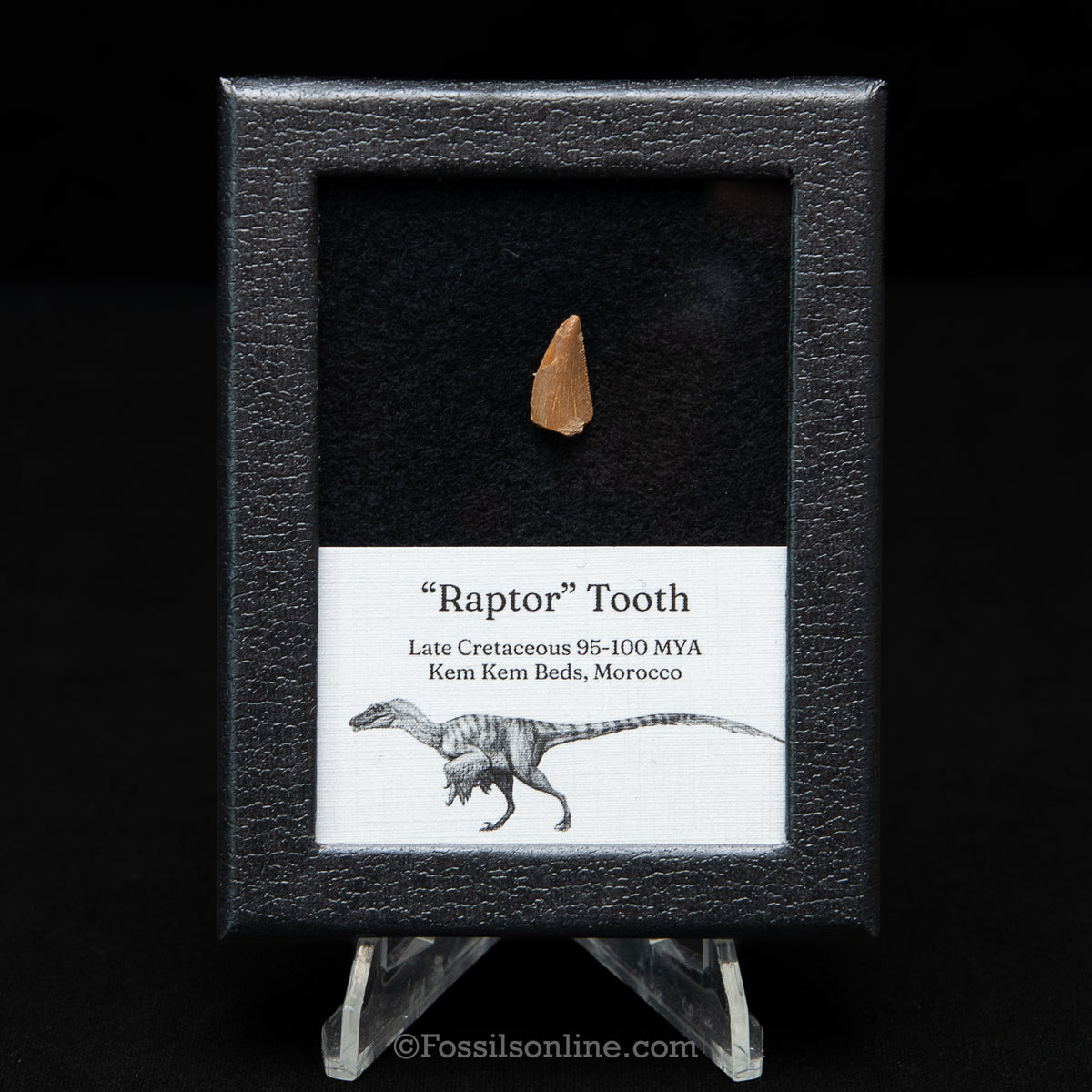


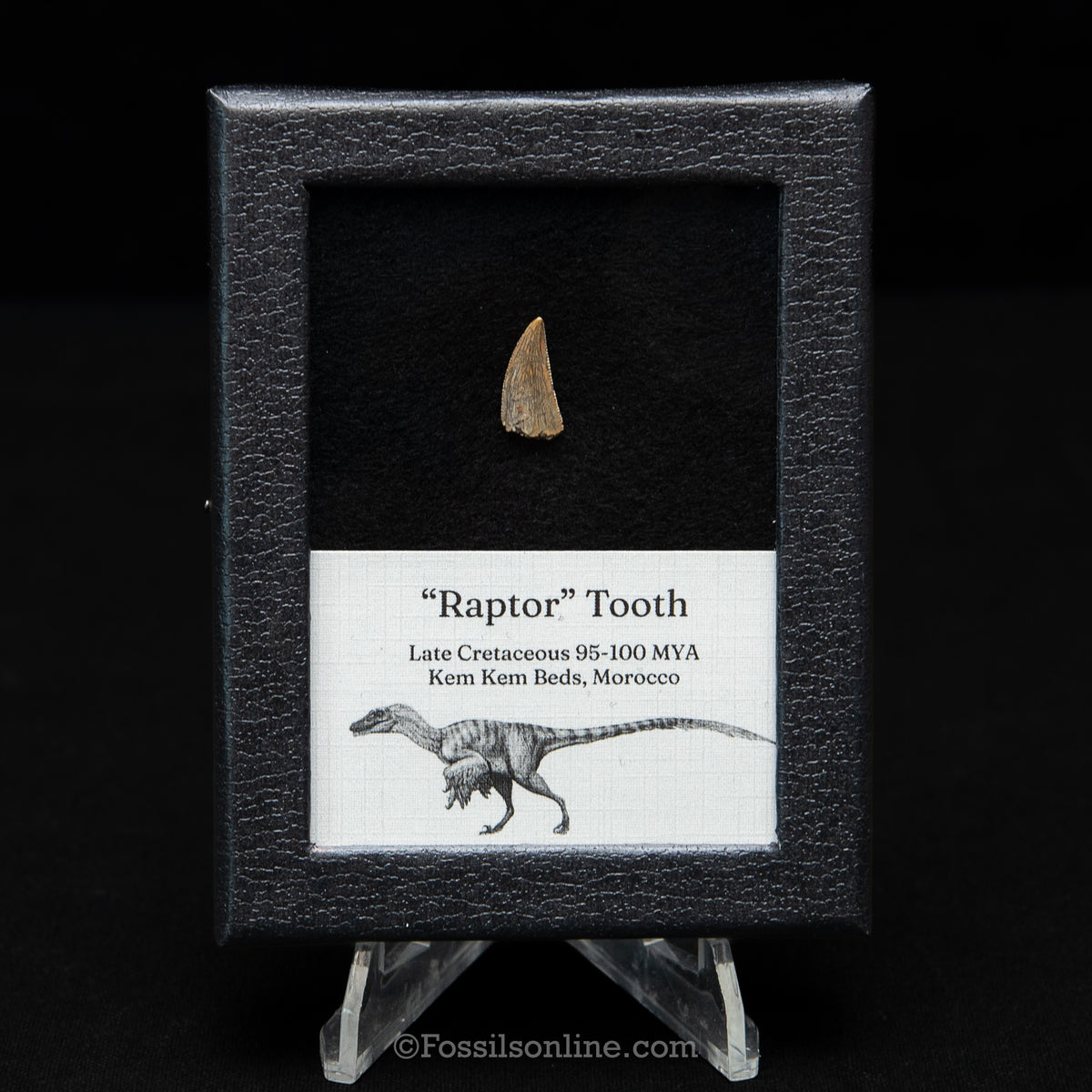


Theropod Dinosaur Tooth "Raptor" in a sm display case
Well-preserved theropod dinosaur tooth from the Late Cretaceous Kem Kem Beds of Morocco, housed in a compact 3.25” x 4.25” display case. These teeth are believed to come from raptor-like theropods—fast, agile predators with sharp claws and serrated teeth. While the exact species has yet to be officially described, fossils from this region are often attributed to dromaeosaurids or similar small to mid-sized predatory dinosaurs.
In the late Cretaceous, around 95 million years ago, the region that is now eastern Morocco was a sprawling river system and coastal delta feeding into the Tethys Sea. These sediments, known today as the Kem Kem Beds, preserve one of the most famous fossil faunas in the world: giant predators like Spinosaurus and Carcharodontosaurus, huge crocodile-like reptiles, massive fish—and a whole supporting cast of smaller, agile theropods often nicknamed “raptors” by collectors.
Scientifically, many of these small predatory dinosaurs are known mostly from isolated teeth and fragmentary bones, so their exact family (true dromaeosaurids vs. other small theropods) is still being debated. In the fossil trade, though, they’re widely referred to as Kem Kem raptors—fast, lightly built meat-eaters that once darted through the floodplains beneath the shadows of the giant carnivores.
Discovery and fragmentary nature
Unlike headline dinosaurs with complete skeletons, Kem Kem raptors were “discovered” piece by piece:
-
Small, recurved, serrated teeth dug from the red sandstones of the Kem Kem Group.
-
Occasional bits of jaw, limb bones, and vertebrae from small theropods.
Early on, some of these teeth were assigned to dromaeosaurids (true raptors) because their shape—curved, laterally compressed, with sharp serrations—looked similar to raptor teeth from North America and Asia. Later work has shown that it’s very hard to be certain from teeth alone; some may belong to other small theropod groups.
The result is a bit like having a bag of puzzle pieces but no picture on the box. We know small, agile predators were present in the Kem Kem ecosystem, but we don’t yet have a beautiful, complete skeleton to show exactly what they looked like. Much of the fine-scale information about these little hunters is effectively “missing” until more complete material turns up.
Size and where they lived
Kem Kem raptors were small to medium-sized theropods, especially when compared to the giants around them:
-
Probably a few meters long at most (roughly human-sized or a bit larger).
-
Lightly built, with narrow, blade-like teeth suited to slicing flesh rather than crushing bone.
They lived along the rivers, floodplains, and delta channels of the Kem Kem system—an environment packed with fish, amphibians, crocodile-like reptiles, flying pterosaurs, and large herbivorous dinosaurs. It was a warm, seasonally wet landscape, with channels that flooded and shifted, leaving behind layers of sandstones and mudstones that now form the famous fossil beds.
How they differ from the big predators
The Kem Kem fauna is famous for oversized carnivores—Spinosaurus, Carcharodontosaurus, and big abelisaurids—but the raptors filled a very different niche:
-
Body build – Smaller, lighter, and likely more agile, built for quick strikes and rapid movement rather than sheer power.
-
Tooth design – Narrow, recurved, and sharply serrated teeth designed to slice rather than crush. Spinosaurus had conical fish-grabbing teeth; Carcharodontosaurus had massive steak-knife teeth; the small Kem Kem raptors had more delicate but deadly slicing blades.
-
Prey choice – Instead of tackling the very largest dinosaurs or giant fish, these raptors probably targeted smaller dinosaurs, juveniles, carrion, and medium-sized vertebrates—the kind of prey a fast, agile hunter could overwhelm.
Think of them as the middle-weight predators of the Kem Kem ecosystem: not the biggest killers on the block, but quick, efficient, and numerous.
Lifestyle – fast, opportunistic hunters
Because we mostly have teeth, we have to reconstruct lifestyle from comparisons with better-known raptors elsewhere:
-
They likely hunted using speed and precision, not brute force.
-
Serrated, recurved teeth suggest a feeding style of slashing and tearing, taking bites that could bleed prey out or strip flesh quickly.
-
In a river-dominated environment full of hazards (giant crocs, big theropods, deep channels), smaller predators probably relied on stealth, agility, and quick retreats.
It’s possible some forms hunted in small groups, as has been hypothesized for other raptors, but we don’t yet have direct fossil evidence for pack behavior in the Kem Kem material. What’s certain is that these small predators were an important part of the food web, picking off smaller animals and cleaning up leftovers the giants left behind.
Why Kem Kem “raptor” teeth are so common and affordable
If these are real dinosaur predators, why are their teeth relatively common and affordable, especially compared to something like T. rex?
-
Perfect tooth-preserving environment
The Kem Kem Beds are made up of river and delta deposits that are excellent at concentrating and preserving teeth. Sandy channels and flood deposits tend to bury and protect hard parts like teeth, then later release them again as the rocks erode. -
Lots of predators, lots of teeth
The Kem Kem ecosystem hosted many different theropods, including both giants and smaller forms. Each predatory dinosaur replaced teeth throughout its life—so over millions of years, enormous numbers of teeth ended up in the sediment. -
Size and durability
Small to medium-sized teeth are tough and easy to preserve. They don’t break under their own weight as easily as giant teeth, and they can survive transport in rivers better than big, fragile bones. -
Active collecting and export
The Kem Kem Beds are heavily worked by local collectors, who surface-collect and mine teeth and other fossils that then enter the international market. That steady stream of material keeps prices lower than for theropod teeth from rarer, more tightly controlled formations like those that yield T. rex.
All of this means a lot of genuine Kem Kem raptor teeth are available. They’re still real dinosaur predator fossils—but the combination of abundant source rock, tooth-friendly environments, and active collecting makes them far more accessible than teeth from marquee genera.
How they compare to the giants: Spinosaurus and Carcharodontosaurus
In the same rocks where these raptor teeth are found, you also get the heavyweights:
-
Spinosaurus – Huge, semi-aquatic predator with conical fish-grabbing teeth and a tall sail.
-
Carcharodontosaurus – Giant land predator with massive, serrated blade-like teeth.
Compared to those:
-
Raptor teeth are smaller and more numerous, so they’re dramatically more affordable.
-
They lack the individual name recognition of Spinosaurus or Carcharodontosaurus, but they represent the same ecosystem and a very different hunting strategy.
-
On a display shelf, a good Kem Kem raptor tooth pairs beautifully with a big Spinosaurus or Carcharodontosaurus tooth: one shows the giant apex predator, the other the fast, slicing mid-tier hunter that shared its world.
What their teeth tell us
Even without complete skeletons, the teeth themselves hold a lot of information:
-
Recurved shape – Teeth curve backward, helping hold onto struggling prey and slice as the jaw pulls back.
-
Serrations – Fine, sharp serrations along the edges act like a micro-saw, cutting flesh efficiently.
-
Cross-section – Laterally compressed (flattened side-to-side), which is typical of meat-slicing teeth rather than bone-crushing ones.
For collectors, each tooth is a tiny, functional piece of dinosaur weaponry—designed by evolution for precision cutting. Under magnification, you can often see the serrations and texture that once helped this animal feed.
A story that’s still being written
One of the most interesting things about Kem Kem raptors is how unfinished their story is:
-
We know they were there, from abundant teeth and a scattering of bones.
-
We know they shared their rivers with some of the largest predators ever to walk the Earth.
-
But we don’t yet have a beautiful, articulated skeleton to show exactly what each species looked like.
Future discoveries may reveal whether some of these teeth truly belong to classic dromaeosaurid “raptors,” or to other small theropod families. For now, each new specimen adds a bit more information to the puzzle.
Why people love collecting Kem Kem “raptor” teeth
Kem Kem raptor teeth are popular because they hit a perfect mix of qualities:
-
Real dinosaur predator fossils from a world-famous locality.
-
Affordable enough that many collectors can own multiple specimens.
-
Visually striking – recurved blades with sharp serrations and attractive desert-patina colors.
-
Rich backstory – tied to the same rivers that produced Spinosaurus, Carcharodontosaurus, giant crocs, and huge fish.
Whether it’s your first theropod tooth or another addition to a serious collection, a Kem Kem “raptor” tooth is a great way to hold a piece of that Cretaceous Moroccan ecosystem in your hand—one small, deadly tooth from a fast little hunter that once shared the water’s edge with some of the biggest carnivores of all time.
Well-preserved theropod dinosaur tooth from the Late Cretaceous Kem Kem Beds of Morocco, housed in a compact 3.25” x 4.25” display case. These teeth are believed to come from raptor-like theropods—fast, agile predators with sharp claws and serrated teeth. While the exact species has yet to be officially described, fossils from this region are often attributed to dromaeosaurids or similar small to mid-sized predatory dinosaurs.
In the late Cretaceous, around 95 million years ago, the region that is now eastern Morocco was a sprawling river system and coastal delta feeding into the Tethys Sea. These sediments, known today as the Kem Kem Beds, preserve one of the most famous fossil faunas in the world: giant predators like Spinosaurus and Carcharodontosaurus, huge crocodile-like reptiles, massive fish—and a whole supporting cast of smaller, agile theropods often nicknamed “raptors” by collectors.
Scientifically, many of these small predatory dinosaurs are known mostly from isolated teeth and fragmentary bones, so their exact family (true dromaeosaurids vs. other small theropods) is still being debated. In the fossil trade, though, they’re widely referred to as Kem Kem raptors—fast, lightly built meat-eaters that once darted through the floodplains beneath the shadows of the giant carnivores.
Discovery and fragmentary nature
Unlike headline dinosaurs with complete skeletons, Kem Kem raptors were “discovered” piece by piece:
-
Small, recurved, serrated teeth dug from the red sandstones of the Kem Kem Group.
-
Occasional bits of jaw, limb bones, and vertebrae from small theropods.
Early on, some of these teeth were assigned to dromaeosaurids (true raptors) because their shape—curved, laterally compressed, with sharp serrations—looked similar to raptor teeth from North America and Asia. Later work has shown that it’s very hard to be certain from teeth alone; some may belong to other small theropod groups.
The result is a bit like having a bag of puzzle pieces but no picture on the box. We know small, agile predators were present in the Kem Kem ecosystem, but we don’t yet have a beautiful, complete skeleton to show exactly what they looked like. Much of the fine-scale information about these little hunters is effectively “missing” until more complete material turns up.
Size and where they lived
Kem Kem raptors were small to medium-sized theropods, especially when compared to the giants around them:
-
Probably a few meters long at most (roughly human-sized or a bit larger).
-
Lightly built, with narrow, blade-like teeth suited to slicing flesh rather than crushing bone.
They lived along the rivers, floodplains, and delta channels of the Kem Kem system—an environment packed with fish, amphibians, crocodile-like reptiles, flying pterosaurs, and large herbivorous dinosaurs. It was a warm, seasonally wet landscape, with channels that flooded and shifted, leaving behind layers of sandstones and mudstones that now form the famous fossil beds.
How they differ from the big predators
The Kem Kem fauna is famous for oversized carnivores—Spinosaurus, Carcharodontosaurus, and big abelisaurids—but the raptors filled a very different niche:
-
Body build – Smaller, lighter, and likely more agile, built for quick strikes and rapid movement rather than sheer power.
-
Tooth design – Narrow, recurved, and sharply serrated teeth designed to slice rather than crush. Spinosaurus had conical fish-grabbing teeth; Carcharodontosaurus had massive steak-knife teeth; the small Kem Kem raptors had more delicate but deadly slicing blades.
-
Prey choice – Instead of tackling the very largest dinosaurs or giant fish, these raptors probably targeted smaller dinosaurs, juveniles, carrion, and medium-sized vertebrates—the kind of prey a fast, agile hunter could overwhelm.
Think of them as the middle-weight predators of the Kem Kem ecosystem: not the biggest killers on the block, but quick, efficient, and numerous.
Lifestyle – fast, opportunistic hunters
Because we mostly have teeth, we have to reconstruct lifestyle from comparisons with better-known raptors elsewhere:
-
They likely hunted using speed and precision, not brute force.
-
Serrated, recurved teeth suggest a feeding style of slashing and tearing, taking bites that could bleed prey out or strip flesh quickly.
-
In a river-dominated environment full of hazards (giant crocs, big theropods, deep channels), smaller predators probably relied on stealth, agility, and quick retreats.
It’s possible some forms hunted in small groups, as has been hypothesized for other raptors, but we don’t yet have direct fossil evidence for pack behavior in the Kem Kem material. What’s certain is that these small predators were an important part of the food web, picking off smaller animals and cleaning up leftovers the giants left behind.
Why Kem Kem “raptor” teeth are so common and affordable
If these are real dinosaur predators, why are their teeth relatively common and affordable, especially compared to something like T. rex?
-
Perfect tooth-preserving environment
The Kem Kem Beds are made up of river and delta deposits that are excellent at concentrating and preserving teeth. Sandy channels and flood deposits tend to bury and protect hard parts like teeth, then later release them again as the rocks erode. -
Lots of predators, lots of teeth
The Kem Kem ecosystem hosted many different theropods, including both giants and smaller forms. Each predatory dinosaur replaced teeth throughout its life—so over millions of years, enormous numbers of teeth ended up in the sediment. -
Size and durability
Small to medium-sized teeth are tough and easy to preserve. They don’t break under their own weight as easily as giant teeth, and they can survive transport in rivers better than big, fragile bones. -
Active collecting and export
The Kem Kem Beds are heavily worked by local collectors, who surface-collect and mine teeth and other fossils that then enter the international market. That steady stream of material keeps prices lower than for theropod teeth from rarer, more tightly controlled formations like those that yield T. rex.
All of this means a lot of genuine Kem Kem raptor teeth are available. They’re still real dinosaur predator fossils—but the combination of abundant source rock, tooth-friendly environments, and active collecting makes them far more accessible than teeth from marquee genera.
How they compare to the giants: Spinosaurus and Carcharodontosaurus
In the same rocks where these raptor teeth are found, you also get the heavyweights:
-
Spinosaurus – Huge, semi-aquatic predator with conical fish-grabbing teeth and a tall sail.
-
Carcharodontosaurus – Giant land predator with massive, serrated blade-like teeth.
Compared to those:
-
Raptor teeth are smaller and more numerous, so they’re dramatically more affordable.
-
They lack the individual name recognition of Spinosaurus or Carcharodontosaurus, but they represent the same ecosystem and a very different hunting strategy.
-
On a display shelf, a good Kem Kem raptor tooth pairs beautifully with a big Spinosaurus or Carcharodontosaurus tooth: one shows the giant apex predator, the other the fast, slicing mid-tier hunter that shared its world.
What their teeth tell us
Even without complete skeletons, the teeth themselves hold a lot of information:
-
Recurved shape – Teeth curve backward, helping hold onto struggling prey and slice as the jaw pulls back.
-
Serrations – Fine, sharp serrations along the edges act like a micro-saw, cutting flesh efficiently.
-
Cross-section – Laterally compressed (flattened side-to-side), which is typical of meat-slicing teeth rather than bone-crushing ones.
For collectors, each tooth is a tiny, functional piece of dinosaur weaponry—designed by evolution for precision cutting. Under magnification, you can often see the serrations and texture that once helped this animal feed.
A story that’s still being written
One of the most interesting things about Kem Kem raptors is how unfinished their story is:
-
We know they were there, from abundant teeth and a scattering of bones.
-
We know they shared their rivers with some of the largest predators ever to walk the Earth.
-
But we don’t yet have a beautiful, articulated skeleton to show exactly what each species looked like.
Future discoveries may reveal whether some of these teeth truly belong to classic dromaeosaurid “raptors,” or to other small theropod families. For now, each new specimen adds a bit more information to the puzzle.
Why people love collecting Kem Kem “raptor” teeth
Kem Kem raptor teeth are popular because they hit a perfect mix of qualities:
-
Real dinosaur predator fossils from a world-famous locality.
-
Affordable enough that many collectors can own multiple specimens.
-
Visually striking – recurved blades with sharp serrations and attractive desert-patina colors.
-
Rich backstory – tied to the same rivers that produced Spinosaurus, Carcharodontosaurus, giant crocs, and huge fish.
Whether it’s your first theropod tooth or another addition to a serious collection, a Kem Kem “raptor” tooth is a great way to hold a piece of that Cretaceous Moroccan ecosystem in your hand—one small, deadly tooth from a fast little hunter that once shared the water’s edge with some of the biggest carnivores of all time.
AGE
late Cretaceous
LOCATION
Kem Kem Basin, Morocco
Size
.45"-.55"
Choose options