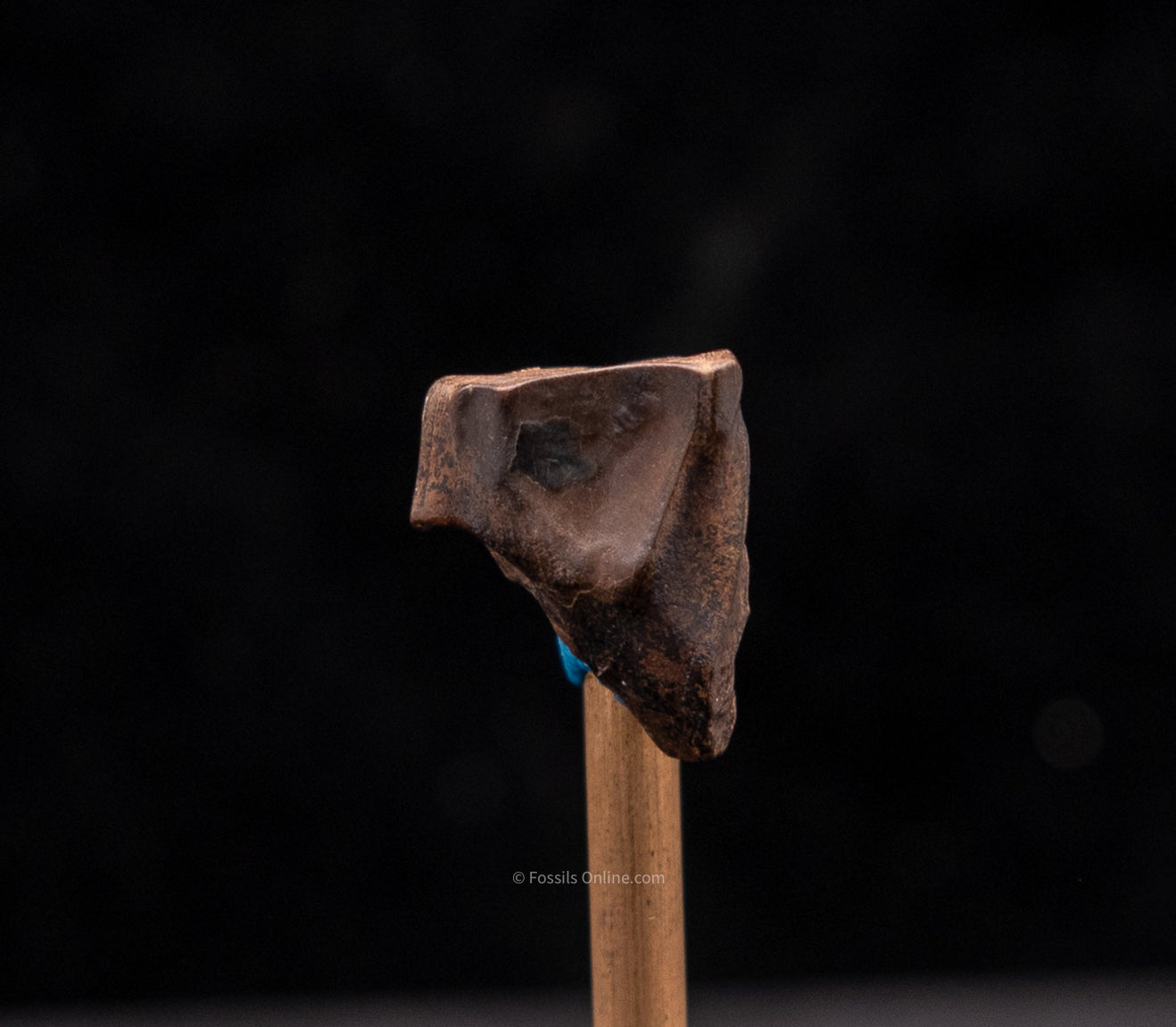
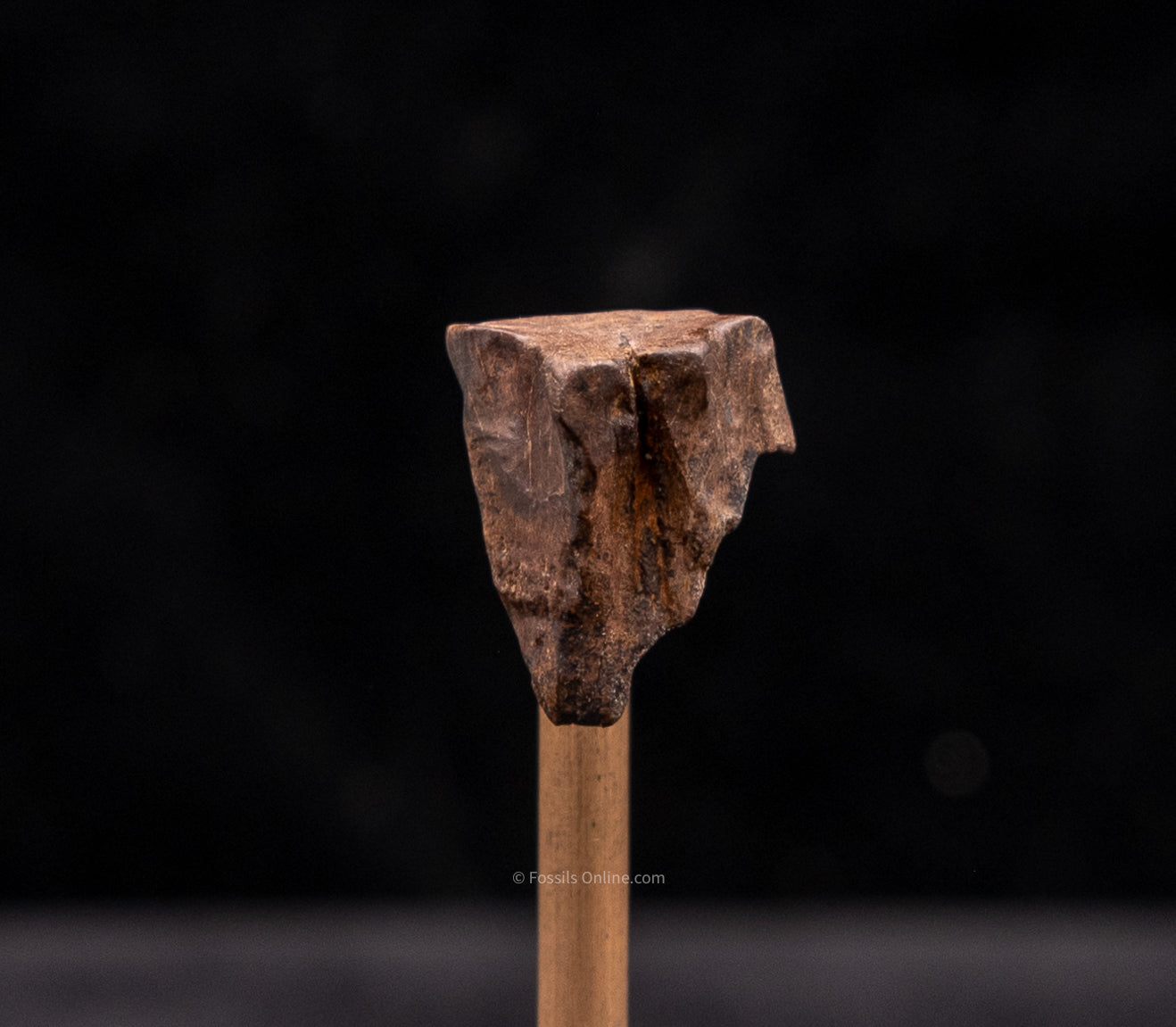
Triceratops Tooth .72”
Triceratops tooth.
Triceratops is one of the most recognizable dinosaurs on Earth: a massive four-legged herbivore with a huge skull, three horns, and a broad bony frill. It lived at the very end of the Cretaceous Period, about 68–66 million years ago, in what is now western North America. These animals roamed lush river valleys and floodplains alongside Tyrannosaurus rex and other late Cretaceous dinosaurs, browsing tough vegetation and using their horns and frills for defense, display, and social interactions.
From a collector’s perspective, Triceratops fossils are some of the most sought-after dinosaur remains—iconic, scientifically important, and strongly tied to the famous Hell Creek and Lance formations that record the final chapter of the “Age of Dinosaurs.”
The two main species of Triceratops
Most researchers recognize two primary species of Triceratops:
-
Triceratops horridus – Often characterized by a somewhat longer, lower snout and subtle differences in horn and frill shape.
-
Triceratops prorsus – Tends to have a shorter face and more upright brow horns in many specimens.
Both species lived in the same general region (Hell Creek, Lance, and related formations in Montana, Wyoming, the Dakotas, etc.). Some scientists think T. horridus may represent an earlier form, with T. prorsus appearing later, possibly reflecting evolutionary change over time as the environment and ecosystems shifted in the last few million years before the extinction event.
Similar horned dinosaurs and the “Torosaurus question”
Triceratops belongs to the ceratopsid family, a group of horned dinosaurs that includes a variety of spectacular skull shapes and frills. Some close or comparable relatives include:
-
Torosaurus – A huge horned dinosaur with a very long frill and large openings (fenestrae) in the frill. A major debate in paleontology is whether Torosaurus is a separate genus or simply the fully mature growth stage of Triceratops.
-
Chasmosaurus, Pentaceratops, Anchiceratops, Styracosaurus, and others – These genera share the basic body plan (beak, horns, frill) but differ in horn length, frill shape, and ornamentation.
Compared to many of these, Triceratops had a more compact but very solid frill (no huge openings) and particularly robust brow horns. That thick, solid skull construction and massive head are part of why Triceratops fossils—especially skull elements and frill sections—are so impressive in both museum and private displays.
What Triceratops ate
Triceratops was a large, high-throughput herbivore designed to process substantial amounts of plant material every day. Its skull and jaws tell us a lot about its diet:
-
A strong, hooked beak at the front of the mouth to crop and bite off vegetation.
-
Deep jaws with powerful muscles to drive the teeth together.
-
Complex dental batteries in the cheeks (we’ll go into detail next) to shred tough plant matter.
Likely food sources included:
-
Ferns and cycads growing in open areas and under forest canopies.
-
Low shrubs, leaves, and possibly shoots or small branches in floodplain forests.
-
Vegetation around river channels and wetlands, where soils were rich and plants grew densely.
Rather than delicately nibbling, Triceratops seems to have been built to grab, slice, and grind tough vegetation—filling an ecological role similar to a big, heavy browsing/grazing mammal in modern ecosystems.
Teeth and dental batteries – Triceratops’ built-in plant processing machine
One of the most sophisticated features of Triceratops is its dental battery—a highly specialized arrangement of teeth that turned its mouth into a powerful plant-processing machine.
How Triceratops’ dental batteries were built
Instead of a single row of large teeth, Triceratops had:
-
Vertical stacks of small teeth arranged in closely packed columns.
-
Each column held multiple teeth on top of each other, with new teeth forming below and moving up as older teeth wore down.
-
These tooth columns linked together side-by-side, creating a continuous “battery” of grinding surfaces in each jaw.
As the animal chewed, the upper and lower batteries worked together like a set of self-sharpening shears:
-
Teeth wore against each other, maintaining fresh cutting surfaces.
-
Worn teeth were gradually replaced from below, so the battery was always “loaded” with functional teeth.
This design allowed Triceratops to process extremely tough, abrasive plants that would have quickly destroyed simpler tooth arrangements. It could grind through fibrous stems, leaves, and possibly even woody material, extracting as many nutrients as possible from each mouthful.
How dental batteries evolved and why they mattered
Dental batteries are an advanced adaptation that evolved in several herbivorous dinosaur groups. In Triceratops and other ceratopsians, this system was a key reason they could thrive as dominant herbivores:
-
Efficient chewing – Many earlier dinosaurs simply snipped plants and swallowed them more or less whole. Triceratops could actually chew, breaking food down before it reached the stomach, which increases digestion and energy gain.
-
Handling abrasive food – Plants often contain grit, silica, and other abrasive particles. Constant wear would ruin simple teeth, but in a battery, worn teeth are continually replaced, so the animal stays effective as a feeder throughout its life.
-
Supporting large body size – To maintain a body weighing several tons, you need a reliable, high-volume food processing system. Dental batteries gave Triceratops that capacity.
Over evolutionary time, ceratopsians went from more primitive beaked dinosaurs with simpler teeth to highly specialized forms like Triceratops with deep jaws and powerful batteries. This reflects a long arms race with changing vegetation—where plants evolve new defenses (like toughness and silica) and herbivores evolve better “hardware” to keep eating them.
Other dinosaurs with dental batteries
Triceratops shares this battery approach with a few other major herbivore groups:
-
Hadrosaurs (duck-billed dinosaurs) – Perhaps the most extreme dental batteries in any dinosaur. Some hadrosaur jaws contained hundreds of teeth in complex, interlocking stacks. They were superb at grinding plants and may have fed on a wide variety of vegetation, including especially tough material.
-
Other ceratopsians – Relatives like Centrosaurus, Chasmosaurus, and others also had dental batteries, though Triceratops stands out as one of the largest and most robust users of this system.
These dinosaurs show how successful the battery strategy was: both ceratopsians and hadrosaurs became incredibly abundant in Late Cretaceous ecosystems, dominating plant-eating niches across large parts of North America and Asia.
For collectors, Triceratops teeth may appear small compared to the size of the animal, but each one is a piece of that highly engineered chewing system—a specialized tooth that once sat inside a living conveyor belt of constantly renewing enamel.
Why Triceratops was so common in its ecosystem
Within its habitat, Triceratops functioned as a “keystone” herbivore—a very common, very large plant-eater:
-
It filled the same ecological role we see today in herds of bison, wildebeest, or other big grazers and browsers.
-
Over millions of years, countless generations lived and died along rivers and floodplains, leaving skeletal remains in sediments that occasionally preserved as fossils.
-
Their size and bone density increased the chances that at least some remains survived burial, compaction, and time.
That said, Triceratops fossils are still far less common than marine shark teeth or many small, durable fossils. One Triceratops might leave one skeleton (which could be scattered or destroyed), while a single shark can produce thousands of teeth in its lifetime. So even though Triceratops was common in life, each fossil still represents a relatively rare and important find.
Predators – life with Tyrannosaurus rex
Triceratops shared its world with Tyrannosaurus rex, and their relationship is preserved directly in the fossil record:
-
Triceratops bones and skulls often show distinctive T. rex tooth marks—deep gouges and punctures that match the size and shape of tyrannosaur teeth.
-
Some of those marks show signs of healing, meaning the Triceratops survived an attack.
-
Others show no healing and appear on disarticulated bones, which suggests scavenging or feeding on carcasses.
This tells us:
-
T. rex did hunt or at least attack Triceratops at times.
-
Triceratops was not easy prey; a large adult with forward-swept horns and a huge, muscular body could seriously injure a predator.
-
T. rex probably took advantage of both live prey and fallen individuals, just like many large predators today.
When you hold a piece of Triceratops bone, you’re holding part of an animal that lived in a high-stakes predator–prey ecosystem, facing down one of the fiercest land carnivores ever discovered.
Growth and life stages
Triceratops changed dramatically as it grew:
-
Juveniles – Smaller bodies, shorter frills, and horns that were initially shorter and more curved.
-
Subadults – Skulls lengthen, frills expand, and the horns start to swing forward and grow heavier. Bone texture still shows signs of rapid growth.
-
Adults – Massive skulls, fully developed frills, and large brow horns angled forward. Bone becomes denser and smoother, showing maturity.
These growth changes are important for both science and collecting:
-
They explain why Triceratops skulls can look so different from one another—many reflect different ages, not necessarily different species.
-
Some debates (like the Torosaurus vs. Triceratops question) hinge on whether certain skulls represent extreme adults rather than separate genera.
For collectors, a piece of bone or frill can sometimes be identified as coming from a younger vs. older animal based on bone texture and overall robustness.
Why collectors love Triceratops fossils
Triceratops hits a rare combination of features that make it a favorite among collectors:
-
Iconic look – Even non-collectors recognize Triceratops immediately.
-
Ties to T. rex – It lived in the same famous Hell Creek/Lance ecosystem, making any Triceratops fossil part of that legendary “final days of the dinosaurs” story.
-
Scientific importance – Every new find helps clarify growth, species differences, and behavior.
-
True rarity compared to common fossils – Authentic Triceratops material is much scarcer than shark teeth or most Ice Age bones, giving even small specimens real significance.
Whether it’s a single tooth from the dental battery, a fragment of frill, or a larger bone, a Triceratops fossil is a tangible piece of a horned titan that once dominated Late Cretaceous floodplains—backed by one of the most advanced plant-processing systems ever evolved by a dinosaur.
AGE
Cretaceous
LOCATION
Garfield County, MT
FORMATION
Hell Creek
Size
.72"
Choose options